
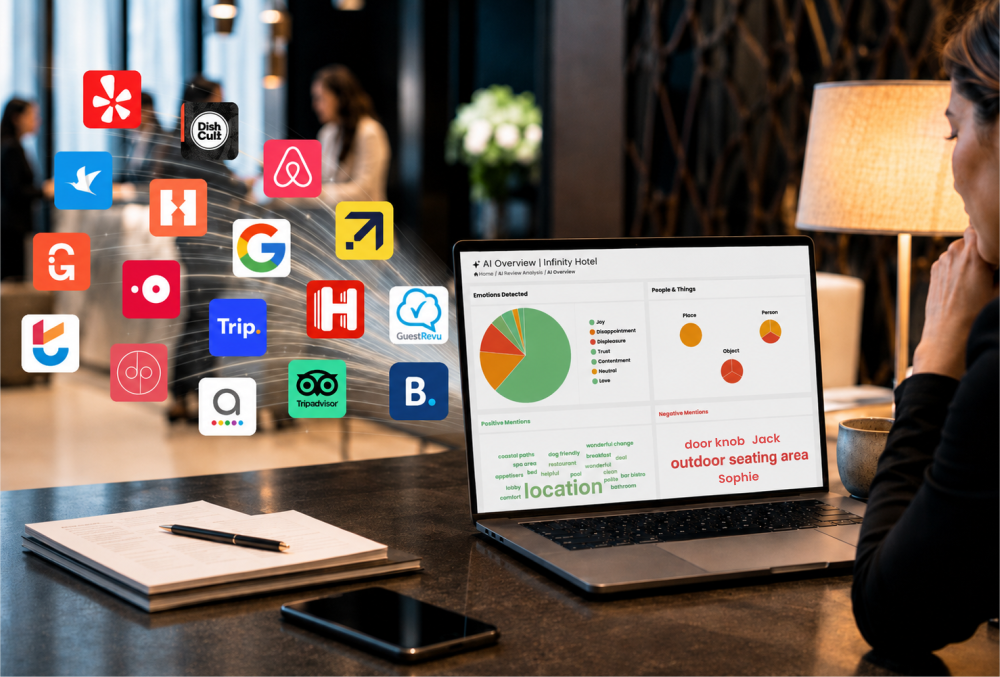

A curious click on your website, the specific room type a guest has chosen, a recurring order in your restaurant, or a detailed online review — every interaction is an opportunity to collect guest data. Every touchpoint becomes a piece of your guest’s story.
In fact, information and communication technology has evolved to the point where we now have data collected from thousands, or even millions, of individual actions at our fingertips. This massive amount of data that we can collect, or simply ‘big data’, enables us to learn about guest profiles, behaviour, and preferences, which in turn allows us to anticipate their needs and expectations.
This is hardly a new concept, though. Businesses have been managing vast volumes of data for years. Big data has always existed, but its power remained in the hands of the fortunate few who had the resources to collect and analyse it.
But it is from these millions of data points that the foundation for today’s powerful generative Artificial Intelligence (AI) has been forged. Now, the real innovation lies in how we manage and analyse this complexity efficiently. Over GuestRevu’s decade-plus in the guest intelligence business, we’ve navigated the evolution from big data to AI-powered analytics. Behind the buzzwords and changing technology, we’ve facilitated the work of hoteliers who have a fundamentally data-backed, guest-centric attitude to hospitality.
The trick is not so much finding the data as figuring out how to use it – how to turn your big data into smart data that provides actionable intelligence to inform your business decisions.
Without a unified view, you miss critical chapters of the guest journey, which can lead to fragmented insights and misinterpreted needs. This is where AI becomes a game-changer, transforming vast, messy hoards of data into a powerful engine for effective management.
In this article, we’ll guide you through the essentials of hotel data management in the AI era, helping you identify the sources already at your fingertips and showing you how to turn that raw information into intelligence that drives your business forward.
Capturing the Guest Story
While accessing big data has become significantly easier, its true value is unlocked only when it is combined with AI to provide the right context. To be a truly effective tool, AI must be powered by big data — specifically your hotel’s own operational data, rather than just industry-standard information.
Without this, you are relying on generic benchmarks rather than your guests’ actual experiences. By feeding AI proprietary data from multiple sources, you transform it from a general assistant into a precision engine that understands the nuances of every stay.
Some of the most common data sources include:
- Property Management System (PMS)
- Booking engine
- Channel manager
- Customer relationship management (CRM)
- Reputation management software
Besides these hotel systems, there are also other direct sources of data, such as:
- The hotel’s website
- Social media
- Surveys
- Loyalty programs
- Phone conversations
- Messaging
- Face-to-face interactions
- And more
All these are sources of guest-related information, including demographics, booking patterns, guest behaviours, interests, and more. First-party guest data is a strategic goldmine; you gain valuable insights while avoiding complex privacy compliance issues, as guests provide this information voluntarily.
Also keep in mind that you are not just collecting info — you are gathering important pieces of the guest’s journey. To truly complete that picture, you shouldn’t overlook one of your most accessible data sources: direct guest feedback and online reviews. Strategically analysing these inputs provides invaluable insights, allowing you to refine your marketing initiatives, personalise services and make informed operational improvements.
Whether you’re doing your analysis manually or using an AI, you should pay special attention to lengthy reviews. They often pinpoint exactly where your hotel may have fallen short, providing the critical insights you need to refine your offerings.
Furthermore, in the era of AI-driven hotel discovery, these reviews serve a dual purpose: they provide actionable data for your business and act as key indicators for AI tools determining whether to recommend your property to potential travellers. This importance is underscored by research from Similarweb, which highlights that 54% of citations in travel-related conversations are driven by reviews and User-Generated Content (UGC).
A note on AI ethics and responsibilityModern technology makes gathering guest data easier than ever. There is a clear willingness to share for the right value; research shows that 89% of Gen Z and 87% of millennials surveyed are willing to share personal information for more tailored offers or experiences, and even 78% of Gen X and 64% of baby boomers will swap personal data for personalised service. However, today’s travellers are increasingly savvy about their digital footprint and wary of how their personal information is handled. While they value personalised experiences, there is a delicate balance between helpful customisation and invasive intrusion. Consequently, treating guest data as a privilege rather than a commodity is essential; maintaining transparency and securing explicit consent are the cornerstones of guest trust. After all, trust is not built on policy alone; it relies on the absolute security of your infrastructure. Upholding this trust demands rigorous protection of your systems, as a breach can shatter the relationship you’ve meticulously built. Data breaches remain a significant concern in the hospitality sector. Businesses anticipate malware and ransomware (71%) and accidental data loss (58%) to be the top security risks. When sensitive details are compromised, the consequences are severe: guests face risks like financial fraud and identity theft, while the hotel suffers lasting reputational damage, financial loss, and significant legal liability. Ultimately, robust cybersecurity is non-negotiable; it is the fundamental shield protecting your guests’ trust and your business’s future. To minimise risk when dealing with AI and LLMs, ensure you are careful to anonymise the data you give to AI and that it is not using your proprietary data to train its models. Why GuestRevu’s customisable AI tools are faster, safer and smarter than off-the-shelf ChatGPT However, even with the strongest defences, incidents can occur, making your response strategy just as critical as your prevention. Even if you never need them, it’s a good idea to have plans in place in the event of a breach; acting swiftly, transparently, and decisively is essential to containing the impact and preserving the long-term integrity of your brand. Human oversight of automated actions is also still essential to address the areas where AI often falls short: contextual understanding and empathy. The recent legal case against The Langham Hotel in Pasadena serves as a cautionary tale of what happens when rate automation operates without human supervision in unexpected circumstances. The hotel faced a lawsuit for charging excessive rates to victims of the January 2025 wildfires. Following the disaster, guests were charged 10% above the pre-fire room rate. The hotel claimed this hike was the result of an automated pricing tool, but it ultimately resulted in a settlement requiring the hotel to pay hundreds of thousands of dollars to affected guests. Technology saw an opportunity to increase revenue, but people expected empathy and understanding. |
From Collection to (Artificial) Intelligence
So you’ve surveyed every guest, collected every online review from all over the web, and have demographic and booking information in your PMS – you have safely and ethically collected thousands of data points. That is just the first step. Effective data-driven hotel management goes far beyond simple collection; it is an active process of organising and leveraging information to drive business performance.
The sheer volume of available data can easily become overwhelming, making it difficult to extract real value. To successfully transform “big data” into “smart data,” you (or your AI assistant) must learn to filter, focusing exclusively on the insights that align with your hotel’s specific goals.
When managed correctly, this data serves as the foundation for optimising your inventory, refining pricing strategies to align with real-time demand, streamlining operations, and — crucially — personalising the guest experience. Treating your data as a strategic asset rather than an archive provides the clarity needed to operate more efficiently and deliver the tailored stays your guests expect.
By identifying the correlations within your guest information, keeping track of operational changes, and interrogating the resulting data to understand the causation, you can move from simple observation to informed decision-making. Ultimately, data only holds true value when it is used to drive action that improves your business. If all of that sounds more like a stats class than hospitality, a well-trained and properly informed AI can be an invaluable asset.
Connecting the Dots
While your data holds the key to powerful decision-making, it’s often trapped in disconnected systems, making it difficult to act upon.
It’s important to note that, in the hospitality industry, the success of any AI initiative depends less on the algorithm itself and more on your data connectivity. It is crucial to select AI solutions that integrate seamlessly into your existing technology ecosystem, rather than operating in isolation. You need a unified tech stack that consolidates these fragments into a single, cohesive view of the guest journey.
When hotels unify data across platforms, they gain a complete picture of who their guests are and what matters to them, rather than a series of unconnected numbers. AI acts as the storyteller here, unveiling the narrative hidden within that data and transforming raw insights into meaningful action. By combining the power of your data with the intelligence of AI, you can move beyond simple observation to deliver memorable experiences that extend far beyond a place to stay.
Forward-thinking hotels are already leveraging AI to automate check-ins, hyper-personalise stays, and resolve maintenance issues before guests notice them. For example, GuestRevu allows you to, among other things, turn concerns into service tickets, measure the impact of changes over time, and create multiple survey types to help analyse different aspects of your offering.
The image below demonstrates how GuestRevu transforms feedback into actionable insights that enhance the guest journey.
With real-world feedback, you can take informed steps to ensure you’re delivering the best possible experience, with AI serving as the engine driving these operational improvements.
As the technology (and hospitality’s relationship with it) matures, AI will be used to transform the guest experience by shifting personalisation from static, top-down campaigns to hyper-contextual, real-time interactions. AI empowers you to, for example, deliver the right upsell at the exact moment of need and alert staff to VIP arrivals. Furthermore, AI makes personalisation a part of every guest’s stay by analysing behavioural signals to suggest ‘next best actions,’ ensuring that your communication feels relevant, immediate, and genuinely helpful.
Ultimately, the goal of “smart data” isn’t just to accumulate more information, but to foster deeper connections with your guests. By fuelling it with your hotel’s own data and embracing AI as a strategic partner, you can turn the noise of daily operations into a clear, compelling narrative of your guest experience.