
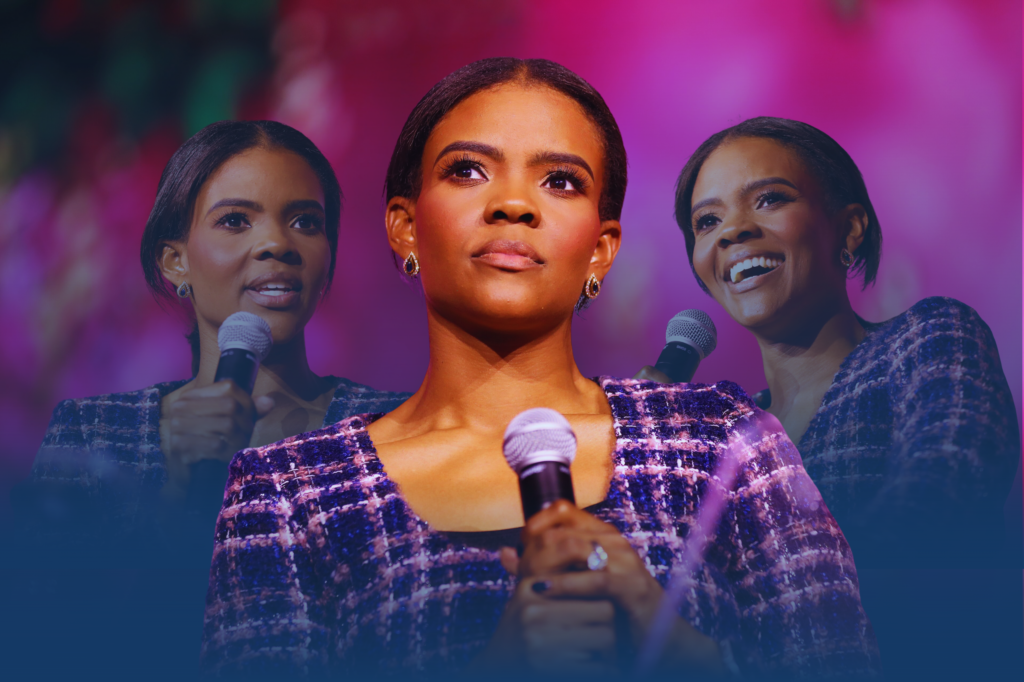

Former Charlie Kirk security chief sues Candace Owens for tying him to assassination conspiracy! Brian Harpole has filed a lawsuit against the infamous political commentator for:
- Defamation,
- Defamation regarding professional unfitness,
- False light invasion of privacy,
- Civil conspiracy to defame,
- Aiding & abetting defamation.
On December 9, 2025, Owens opened her podcast with a punch by alluding to new evidence regarding Kirk’s untimely death (the Turning Point USA founder was assassinated on September 10, 2025.)
Owens said she “cannot see how this [new evidence leads] to anything other than a full confession from the government about the military’s involvement in [Charlie Kirk’s] assassination but [she’s] just going to deliver the facts and see where they land.”
During the episode (Charlie Kirk’s Last Trip to Asia…), Owens revealed a “credible” tip from former military member Mitch Snow (AKA Harry Meyers). He said he saw Harpole at Fort Huachuca on September 9, 2025. Snow claims Harpole was attending a top-secret meeting that included several senior government officers and officials.
Candace Owens has been accused of peddling conspiracy theories before, but she assured her audience “that she had “fact-checked” Snow’s account” and it was “one-hundred percent honest.” In a situation like this, where does protected commentary end and actionable defamation begin?
Brian Harpole Candace Owens Lawsuit Details
Brian Harpole alleges that “Owens and Snow agreed to enter into a conspiracy to defame [him] by using Owens’s network, including her podcast, social media accounts, and websites, to spread this maliciously false theory.”
Owens expressly adopts and endorses Snow’s story. She even “represents that she would assist him by fundraising and supporting his efforts to pursue and publicize these fallacious claims.” Brian Harpole’s complaint highlights Owens’ lack of explanation as to “how this was done or what indicia of credibility supported her conclusion.”
Owens has only cited Snow’s confidence in his account, as well as his description of the alleged meeting, as proof of credibility. (Apparently, the meeting was “the type that is typically held “ahead of an operation.”)
Harpole provided travel records as evidence to the contrary. According to the flight log, he was in Dallas, Texas on September 9—not Fort Huachuca. Candace Owens “had access to [his travel] records, but dismissed them without any investigation, claiming they did not provide an alibi for when the meeting was concluded.”
A few days after the podcast episode was released, Owens also began asserting on X that Harpole lied about what transpired on the day Kirk was killed. However, she—yet again— “failed to specify any statements by Harpole that were allegedly false and presented no evidence to support her conclusion…”
Owens continued to poke the bear for over a week then asked if Harpole wanted to “have an off the record discussion” on December 17, 2025. He didn’t want to be “cajoled” into giving “her the “exclusive content” of a response,” so he never replied. Harpole knew “she stood to profit from increased attention and viewership to her platform at [his] expense.”
Brian Harpole vs Candace Owens Conspiracy Claims
Directly from Brian Harpole’s complaint, Candace Owens claims:
- “… that Snow witnessed Harpole leaving a meeting where he was conspiring with the military and/or federal government to have Charlie Kirk assassinated.”
- “… a man in the military alleges with extreme confidence that he saw Brian Harpole at a military base in Arizona on September 9th. September 9th would in no way conflict with the dates Charlie spoke in Korea…”
- “Brian Harpole has already been caught lying about what transpired on that day. Did he also lie about having place a 911 call? Did no one from their team call 911 after Charlie was shot?”
- “Charlie Kirk’s security officer that didn’t do so much as pack his wound after he was shot.”
- “… she had been “given travel logs for Brian Harpole and it is entirely possible that Brian Harpole could have made it for that meeting. I can tell you that definitively. Brian Harpole could have made it to that base for that early morning meeting.”
- “Harpole knew Kirk was going to die on September 10, 2025, and that is why he did not make security arrangements beyond that date.”
Directly from Brian Harpole’s complaint, he claims that Candace Owens:
- “… through at least eight separate statements published on X and disseminated via her podcast, falsely and negligently, if not intentionally and with reckless disregard for the truth, alleged that [he]… colluded with the government in connection with that assassination.”
- “… therefore also accused him of conspiracy to commit murder, a criminal offense.”
- “… has, and continues to, publish defamatory remarks accusing [him] of foreknowledge of, involvement in, and cover-up of Charlie Kirk’s assassination.”
- “… intentionally ignored all documents and evidence contradicting her narrative…”
- “… failed to investigate obvious doubts such as the authenticity of the incidence report.”
- “… has made at least six separate statements suggesting that [he] and his team failed to perform their duties competently, causing the death of Charlie Kirk.”
- “… intentionally misrepresented and concealed material facts known to her…”
Why Harpole Has a Stronger Actual Malice Case Than Most Influencer Defamation Suits
Candace Owens confirmed on X that she viewed Brian Harpole’s flight records “by the time she had recorded and published her podcast episodes.” She could have (and should have) ceased peddling a false narrative after viewing substantiated evidence that proved “it was “physically impossible” for Harpole to have attended the alleged meeting…” But Owens didn’t. Instead, the political commentator “tripled down on her support for Snow’s false story.”
Harpole’s legal team argues that Owen’s conduct meets the actual malice standard. He has asked the judge for a jury trial.
Actual Malice Standards for Public Figures
Public officials, all-purpose public figures, and limited-purpose public figures face a higher burden of proof in defamation lawsuits.
Private citizens need only prove simple negligence when filing a defamation lawsuit. Simple negligence is when someone fails to behave with the level of care that someone ordinarily would have exercised.
Celebrities and prominent business owners (all-purpose public figures), and individuals distinguished in a specific field or controversy (limited-purpose public figures), must prove actual malice.
Actual malice is when an author knowingly publishes a lie, seriously doubts the validity of information but publicizes it anyway, or has reckless disregard for the truth (shoddy due diligence).
Additionally, the allegations against Brian Harpole amount to defamation per se. Owens’s commentary painted Harpole as someone who engages in criminal activity and professional misconduct.
What is Defamation Per Se?
False accusations of:
- Criminal Activity
- Sexual Misconduct
- Loathsome Disease
- Professional Incompetency or Misconduct
Damages are presumed to exist in cases of defamation per se due to the inherently harmful nature of the fictitious or fabricated claim(s).
Candace Owens has also claimed to have the incident report from Mitch Snow’s visit to Fort Huachuca. She published a screenshot of the document on X as proof. The image, however, showed “a cursor on the screen, indicating that the screenshot was taken as the text was being typed.”
Harpole Owens lawsuit Discovery Implications
Although discovery is helpful, it can be a painful process. As a matter of fact, most defendants in internet defamation cases know it’s best to try and resolve the case before discovery.
Brian Harpole’s lawyers may be able to obtain a forensic copy of Candace Owens’ device(s). Filing against her gives Harpole subpoena power over podcast guests and internal communications. From text and email exchanges to redactions and protective orders, nothing is off limit.
Lessons for Content Creators: How This Case Could Reshape Podcast Liability Post-Charlie Kirk
The danger with conspiracy content is that it often starts with legitimate questions, then jumps to factual accusations before the evidence catches up. Costuming factual accusations as ‘just asking questions’ won’t save you.
The First Amendment protects ugly, reckless, and unfair speech from government censorship—it does not grant immunity from defamation claims, platform consequences, or public criticism.
We’ve seen time and time again that publishing unverified or false claims has real consequences. Take Sandy Hook Families v. Alex Jones / Infowars (2022), for instance. Multiple victims’ families sued conspiracy theorist Alex Jones, and his platform Infowars, for repeatedly asserting that the Sandy Hook shooting was a hoax staged by crisis actors.
In 2022, Jones was ordered to pay $1.4 billion in damages for defamation and emotional distress. He filed for bankruptcy shortly after. The presiding judge also issued a court order, demanding the liquidation of Infowars’ parent company. In 2025, Alex Jones filed an appeal, but the U.S. Supreme Court refused to hear it. As a result, Infowars shut down and the website officially went offline in April 2026.
This case is a stark warning for bloggers, podcasters, and alternative media: spreading harmful falsehoods about private individuals, especially grieving families, carries extreme financial, operational, and reputational risk.
Zachary Young v. CNN (2024) is another relevant example. A CNN segment focused on private evacuation efforts for Afghans fleeing the Taliban after the U.S. withdrawal. Reports of a “black market” involving exorbitant fees and exploitation were widely publicized. The story prominently featured Young’s image and name as an example.
Young argued that the network falsely implied that he had engaged in illegal profiteering or “black market” activities. He claimed that CNN acted with actual malice, citing internal communications where reporters allegedly used derogatory language and expressed intent to target him.
The jury awarded Young $5 million in compensatory damages. The network previously issued an on-air clarification/apology in 2022, but the jury still sided with Young after examining the reporting process, fact-checking, and internal evidence.
Candace Owens Likely Defense Angles
Candace Owens was discussing a matter of overwhelming public concern. Her commentary was based on a “credible” tip, and she even interviewed the anonymous source on her podcast to delve deeper into the story. She has already cried ‘free speech’ and continues to assert that her statements were presented as opinion. Owens’ likely defense will be the First Amendment.
The problem, though, is that Candace Owens escalated from theorizing to fact-telling when she explicitly announced—on multiple platforms—that ‘these are the facts, that Snow’s story is the only story.’
Generally, anonymous sources are also protected under the First Amendment. As such, in situations where a witness comes forward with a “credible” tip, you are allowed to rely on their testimony.
However, if you have reasonable doubt or access to contradicting evidence, you could be held liable for publicizing the witness’ story as factual. Owens reviewed Harpole’s flight logs, which placed him in an entirely different state, but disregarded her discovery.
Objectively, Owens’ team will have a hard time defending on the basis of protected speech. As new information is revealed, though, that may change.
FAQ
- Who is Brian Harpole and why is he suing Candace Owens?
Brian Harpole, founder of Integrity Security Solutions and former head of security for Charlie Kirk, is suing Candace Owens for defamation over her repeated claims that he conspired in Kirk’s 2025 assassination.
- What specific accusations did Candace Owens make against Brian Harpole?
Owens alleged Harpole met with Erika Kirk and Army intelligence officers at Fort Huachuca the day before the assassination, implying foreknowledge or involvement. Harpole claims these are verifiably false.
- What are the main claims in the Harpole v. Candace Owens lawsuit?
Defamation, false light invasion of privacy, and civil conspiracy to defame, seeking damages and an injunction to remove the statements.
- When was the Brian Harpole defamation lawsuit filed against Candace Owens?
April 30, 2026, in U.S. District Court.
- Does Candace Owens face similar defamation lawsuits?
Yes, she has faced others (e.g. Brigitte Macron), but this case stands out due to detailed timeline contradictions and business harm alleged.
- What could happen in the Harpole Candace Owens case?
Potential discovery of Owens’ sources and communications, possible settlement, or trial testing actual malice standards for public figures.
- How does this case affect free speech for podcasters?
It highlights the line between protected opinion and actionable false statements of fact that harm reputation, especially when presented as investigative claims