
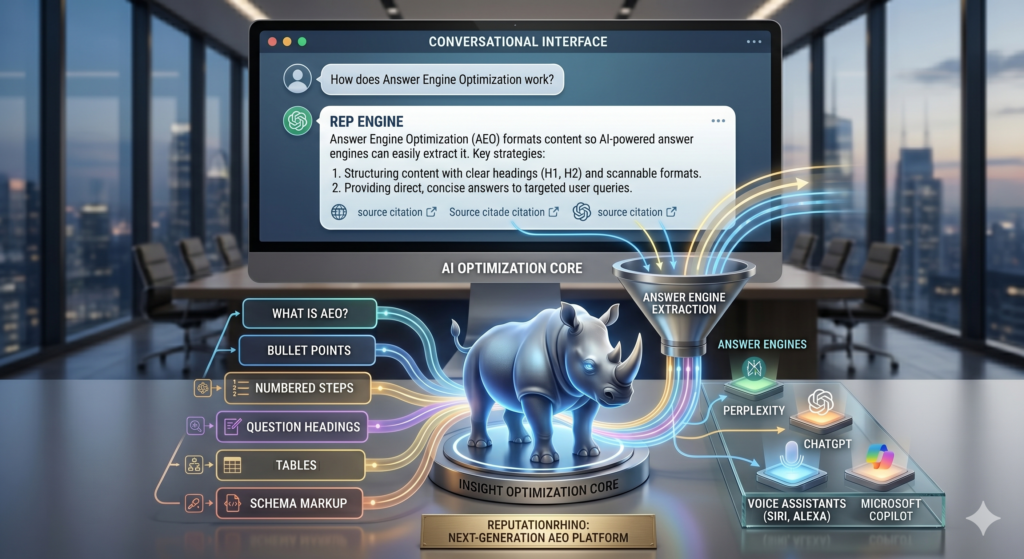

Your brand can lose a prospect before they ever reach your site. AI search tools now answer many questions directly, and those answers often include a source name, a summary, or both. If the tool gets your facts wrong, the mistake spreads fast. That is why answer engine optimization matters now, especially for teams that care about reputation, demand, and pipeline quality.
Search still matters. However, the job has changed. You are no longer only trying to rank, you are trying to be cited accurately.
The brands that win write for humans, but they also structure facts so machines can trust them. That balance is where the work starts.
Why AI citations shape brand trust
AI answers sit closer to the moment of decision than a blue link ever did. A buyer can ask one question and get a neat paragraph back in seconds. If your company name appears there, that line carries weight.
The problem is simple. AI systems do not always pull the right version of your story. They may combine old bios, stale directories, weak press mentions, or thin website copy into a clean-sounding answer. The answer can sound polished and still be wrong.
If your facts change across pages, AI can blend the wrong version into a confident answer.
That is why citation accuracy matters as much as visibility. A mention in an AI answer is more than traffic. It is a label attached to your brand.
For marketers, this changes the goalposts. Ranking still matters, but the page now has to do more than attract clicks. It has to supply facts that are easy to extract, easy to trust, and hard to misread.
For a wider look at how AI search tools summarize sources, SEO Sherpa’s guide to AI search engines is a useful reference.
SEO still matters, but AEO changes the brief
SEO and AEO share a lot of the same ground. Both depend on strong content, clear site structure, and authority signals. The difference is in the output.
SEO tries to win the click. AEO tries to win the answer.
| Area | SEO focus | AEO focus |
|---|---|---|
| Main goal | Earn a visit from search results | Get cited inside an AI answer |
| Page shape | Broader content built for searchers and crawlers | Direct answers, support details, and clean structure |
| Success signal | Rankings, traffic, conversions | Accurate mentions, summaries, and citations |
| Common risk | Thin content or poor relevance | Wrong brand facts or mixed source data |
| Best proof | Backlinks, engagement, authority | Structured facts, source strength, and consistency |
The table makes one thing clear. AEO adds a precision layer on top of classic SEO. It does not replace keyword research, links, or technical work. It asks for cleaner answers and stronger identity signals.
That matters because AI systems often compress a lot of content into a few lines. If your page buries the point, the model may skip it. If your page states the point cleanly, it has a better chance of being used.
A useful way to think about it is this. SEO helps people find you. AEO helps systems describe you correctly. A strong brand needs both.
A 2026 playbook on visibility in ChatGPT, Perplexity, and Google AI Search shows how much of this work now depends on answer-first pages and source clarity.
Write pages AI can quote without confusion
The best AEO pages read like a well-organized brief. They answer the question early, then support the answer with detail. They do not make the reader hunt for the point.
Start with the main answer in the first paragraph. If the page is about a service, say what it does, who it is for, and where it fits. If the page is about a product, say what it solves and who buys it. That opening paragraph often becomes the most useful part for an AI summary.
Next, break the page into short sections with clear headings. Use the questions your buyers already ask. A heading like “How does the service work?” is easier for AI to parse than a clever line that hides the topic.
FAQ-style content helps as well. It lets you place direct questions and direct answers in one place. That format mirrors how users speak to AI tools.
Structured data matters too. Schema markup gives your content labels that machines can read faster. Use the types that match the page, such as Organization, Person, Article, FAQPage, Product, or LocalBusiness. Only mark up facts that are true and visible on the page.
A clean summary box at the top helps as well. Keep it short. Put the brand name, the offering, the audience, and the main location or category there if it applies.
This is where the structure becomes easy to skim and easy to cite.
A simple content pattern works well:
- Lead with the answer.
- Use question-based headings.
- Add short support paragraphs.
- Include FAQs where buyers ask repeat questions.
- Mark up the page with schema that matches the real content.
When a page follows that pattern, AI has less room to guess.
Make your brand facts consistent everywhere
A brand with scattered facts is hard for AI to trust. One page says one thing. Another says something else. A third page still lists an old address or an outdated leader. That confusion travels fast.
For local and service businesses, NAP consistency still matters. Name, address, and phone number should match across the website, directory listings, social profiles, and local citations. The same logic applies to service names, product names, founder names, and brand descriptions.
If your home page calls your offer one thing and your press release calls it something else, AI sees noise. If your contact page, footer, About page, and schema all tell the same story, AI sees a cleaner entity.
That is where entity optimization comes in. The goal is to teach the web who you are, what you do, and how each detail connects. A consistent About page, clear leadership bios, and a strong contact page all help.
Teams that already use online reputation management services can treat this as part of the same discipline. Reputation work and AEO both depend on a stable record.
Authoritativeness signals help too. Use named authors. Add bios with real credentials. Cite sources where claims need proof. Keep the company description the same across key pages. If a service line changes, update it everywhere, not just on the landing page.
The more your site behaves like a single source of truth, the easier it is for AI to quote you correctly.
A brand with one clean story is easier to summarize than a brand with five competing versions of itself.
Use off-site brand references to back up the story
AI systems do not stop at your site. They compare your claims with what other sites say about you. That is why off-site references matter so much.
Media coverage, partner pages, review profiles, industry directories, speaker bios, and association listings all add weight. They do not need to repeat your whole pitch. They just need to confirm the same core facts.
This is where digital PR and AEO overlap. Good coverage should name the company correctly, describe the offer cleanly, and reinforce the same positioning your site uses. A guest quote that says one thing and a partner page that says another create friction.
Use outside mentions with care. Ask whether each source helps a machine verify your brand. A buyer-facing directory profile, a respected trade article, or a strong review platform often helps more than a dozen weak mentions.
For a broader view of how marketers are thinking about AI search placement, this visibility playbook for AI search is a helpful companion.
Google’s AI Mode and other answer systems can work from a smaller slice of the web than classic search. That makes strong, consistent references more important than ever. A visible brand with mixed signals can still lose the citation battle.
Use the outside web as a proof layer. It should echo your site, not argue with it.
Common citation risks that break AI answers
The biggest risks are often boring. They are old files, old listings, and old assumptions left to sit too long.
Outdated citations can send AI down the wrong path. A wrong phone number, a moved office, or a retired service line can survive in directories for months. Conflicting data can do even more damage. If one source says one thing and another says the opposite, AI may blend them.
Weak sourcing is another problem. Pages with no author, no date, and no clear claim are easy to skip. So are pages that sound polished but never name the actual company, offer, or audience. AI likes certainty, but it needs proof.
Hallucinated brand details are the most frustrating issue. AI can invent a founder, merge two companies, or attach a service to the wrong location. Once that happens, the wrong version may show up again and again.
If the damage has already spread, online reputation repair services can help correct the record across search and supporting sources. That work becomes even more useful when AI systems start echoing the mistake.
Watch for these warning signs:
- The same business has different addresses on different pages.
- Your team names change between bios and press coverage.
- Product or service names shift across PDFs, pages, and profiles.
- AI answers mention details your site never published.
These are small cracks that become large enough to matter.
A practical AEO workflow for marketing teams
AEO works best when it becomes a repeatable process. One-off fixes help, but a routine keeps the brand clean.
Start with a fact audit. List the company name, product names, service lines, founders, locations, and key claims. Then check where each fact appears on your site and elsewhere. If the same detail shows up in three forms, you already have a problem.
Next, build or revise the pages that AI is most likely to cite. That usually means the home page, About page, core service pages, product pages, and top FAQ pages. Put the answer near the top and keep the language plain.
Then add schema that matches the page. Use it to label the organization, person, service, and FAQ data that already appears on the page. Skip anything that is not visible to readers.
After that, tighten your off-site references. Update directory profiles, partner bios, press kits, author pages, and review profiles so they all tell the same story. Consistency here saves a lot of cleanup later.
Finally, test the brand in AI tools. Ask the same core questions every month. “What does this company do?” “Who founded it?” “Where is it based?” “What problem does it solve?” Compare the answers and fix the gaps.
The process is simple, but it needs discipline. AEO rewards teams that treat brand facts like infrastructure.
Conclusion
AI search is changing what it means to be visible. The goal is no longer only to earn the click. It is to be quoted with the right facts, in the right context, every time.
That is why answer engine optimization belongs next to SEO, not after it. Clean structure, schema, consistent brand details, and strong off-site references give AI less room to guess.
When the web tells one clear story about your brand, AI has a better chance of repeating it correctly. That is the real win.