


At Reputation Return, we understand that effective reputation management is crucial in today’s digital landscape. The rise of AI-driven search engines has transformed the way businesses approach their online presence. As experts in ensuring businesses get listed in AI search engines and generative search, we help companies thrive in this new environment.
Traditional SEO approaches are no longer sufficient for businesses seeking visibility and credibility online. The convergence of reputation management and search optimization has created a powerful strategy for businesses to succeed. With our expertise, companies can better anticipate sentiment shifts, detect emerging crises, and automate reputation management tasks at scale.
Key Takeaways
- Reputation management is critical for businesses to succeed in AI-driven search environments.
- Effective SEO strategies now require the integration of reputation management.
- Companies that fail to adapt risk becoming invisible in AI-generated search results.
- Reputation Return’s expertise can help businesses enhance visibility and build trust.
- Our comprehensive solutions provide businesses with the tools to drive measurable results.
The Evolution of AI in Search and Reputation Management
As AI continues to transform the digital landscape, its impact on search results and reputation management becomes increasingly significant. The way customers perceive a brand is no longer influenced solely by individual reviews or news articles. Today, AI systems such as Google’s AI Overviews and ChatGPT aggregate reviews, ratings, and social mentions to generate summaries about businesses, shaping customer perception before they even visit a website.
From Static to Dynamic: How AI Has Transformed Search
The advent of AI-powered search engines has transformed the search landscape from static to dynamic. AI now prioritizes reputation signals when determining which businesses to feature in search results and recommendations. This shift has made customer reviews, sentiment analysis, and brand mentions critical factors in how AI evaluates and presents businesses to potential customers.
The Rising Importance of Reputation in AI-Driven Search Results
In AI-driven search results, reputation has become a fundamental component of modern SEO strategy. Google’s AI Overviews and other generative search features create instant brand impressions based on aggregated reputation data across the web. Businesses with strong reputation signals receive preferential visibility, creating a competitive advantage in digital discovery. The correlation between reputation management and search visibility has never been stronger, emphasizing the need for businesses to prioritize their online reputation.
Key aspects of this evolution include:
- AI-powered search engines prioritizing reputation signals in search results and recommendations.
- Customer reviews and sentiment analysis becoming critical in AI’s evaluation of businesses.
- Generative search features creating instant brand impressions based on reputation data.
- Businesses with strong reputation signals gaining preferential visibility and a competitive advantage.
Understanding Reputation AI SEO

As AI continues to transform the digital landscape, understanding Reputation AI SEO has become crucial for businesses aiming to maintain a strong online presence. We specialize in ensuring that your business gets listed in AI search engines and generative search, helping you stay ahead of the competition.
Defining Reputation AI SEO in Today's Digital Landscape
Reputation AI SEO refers to the strategies and practices used to manage and optimize a business’s online reputation in the context of AI-driven search engines. Effective reputation management for AI encompasses several critical components that work together to create a strong digital presence. Customer reviews and feedback are the core input for AI models in the reputation management space, so brands must manage these reviews carefully by providing customers consistent, high-quality responses.
Key Components of Effective Reputation Management for AI
To manage reputation effectively in the AI era, businesses must focus on several key areas:
- Consistent monitoring of brand mentions, reviews, and sentiment across all digital touchpoints provides the foundation for reputation intelligence.
- Strategic content creation that addresses customer concerns, highlights brand values, and demonstrates expertise helps shape how AI interprets your business.
- Review management, including soliciting positive reviews and professionally addressing negative feedback, significantly impacts how AI evaluates your reputation.
- Data analysis capabilities that can identify sentiment trends, competitive positioning, and emerging reputation issues before they affect your business.
- Voice consistency across all digital channels ensures that AI systems recognize and properly attribute your brand’s communications.
By focusing on these components, businesses can improve their online reputation and increase their visibility in AI-driven search results. We are experts at ensuring your business gets listed in AI search engines and generative search, providing comprehensive solutions for digital brand safety.
Why Traditional SEO Strategies Fall Short in the AI Era
As AI continues to evolve, it’s becoming increasingly clear that traditional SEO approaches are no longer effective. The rise of AI-driven search algorithms has significantly altered the way search results are generated, making it essential for businesses to adapt their SEO strategies.
The Limitations of Keyword-Focused Approaches
Traditional SEO strategies often rely heavily on keyword-focused approaches. However, AI-powered search algorithms have become sophisticated enough to understand the context and intent behind user queries, rendering simple keyword stuffing ineffective. AI evaluates content based on its relevance, quality, and ability to satisfy user intent, making it crucial to shift from keyword density to content quality.
- AI search algorithms assess factors like expertise, authoritativeness, and trustworthiness (E-A-T) to determine content credibility.
- Natural language processing capabilities enable AI to comprehend content context, sentiment, and relevance, far surpassing traditional search algorithms.
How AI Evaluates Content Quality and Brand Reputation
AI-driven search results place significant emphasis on brand reputation signals, including review sentiment, mention frequency, and citation quality. To improve visibility, businesses must focus on generating high-quality, sentiment-driven content that showcases their brand’s expertise and trustworthiness.
- Content quality assessment involves analyzing depth of coverage, originality, readability, and how well the content satisfies user intent.
- AI systems can detect patterns across the entire content ecosystem to form a comprehensive evaluation of a brand’s digital reputation and authority.
By understanding how AI evaluates content and brand reputation, businesses can refine their SEO strategies to prioritize quality, relevance, and trustworthiness, ultimately improving their search visibility and online presence.
The Business Impact of AI-Driven Reputation Management
Businesses are experiencing significant benefits from AI-driven reputation management. By leveraging AI tools, companies can automate tasks such as data gathering, analysis, and review responses, reducing the need for large teams while maintaining a strong online presence.
Measurable Benefits for Multi-Location Businesses
For multi-location businesses, AI-driven reputation management offers measurable benefits, including improved efficiency and enhanced insights. AI tools enable these businesses to monitor and respond to customer feedback across multiple locations in real-time, creating a unified brand image.
- AI automation significantly reduces manual labor for reputation management tasks.
- Automated review response systems handle routine customer feedback efficiently.
- Continuous data collection and analysis provide real-time insights without additional staffing costs.
Cost Savings and Efficiency Gains Through AI Automation
AI automation leads to significant cost savings and efficiency gains by streamlining reputation management tasks. Businesses report efficiency improvements and reduced operational expenses, allowing them to reallocate resources to strategic initiatives.
- Businesses achieve 30-50% reductions in reputation management operational expenses.
- AI tools enable smaller businesses to implement enterprise-level strategies.
- The process of reputation management becomes more streamlined and effective.
By adopting AI-driven reputation management, businesses can enhance their online presence, improve customer engagement, and drive long-term success.
How AI Analyzes Your Brand's Reputation
AI-driven reputation analysis transforms how businesses perceive and manage their brand image. By leveraging advanced technologies such as sentiment analysis and natural language processing, AI provides a comprehensive view of a brand’s online presence.
Sentiment Analysis and Natural Language Processing
Sentiment analysis is a crucial component of AI-driven reputation management. It enables businesses to understand the emotional tone behind customer feedback, reviews, and social media conversations. Natural Language Processing (NLP) further enhances this capability by interpreting the nuances of human language, allowing for more accurate sentiment detection.
By continuously monitoring sentiment trends and external data sources, businesses can better detect early signs of negative sentiment or customer dissatisfaction. This proactive approach enables companies to address potential issues before they escalate, safeguarding their brand reputation.
Real-Time Monitoring and Predictive Analytics
AI-powered reputation monitoring systems operate continuously, providing real-time alerts when significant reputation events occur. Predictive analytics capabilities can identify emerging reputation trends before they become widespread, giving businesses a critical early warning system.
These advanced tools not only track mentions across various platforms but also correlate reputation data with business performance metrics. This correlation provides valuable insights into how reputation changes impact key business outcomes, enabling businesses to make informed decisions.
By harnessing the power of AI, businesses can gain a deeper understanding of their brand’s reputation and take proactive measures to maintain a positive online presence.
The Role of Customer Reviews in Reputation AI SEO
Customer reviews play a crucial role in Reputation AI SEO, as they provide valuable feedback that AI systems use to evaluate a business’s reputation. Encouraging customers to leave reviews keeps your content fresh and relevant for your audience. We have found that timing is key—ask happy customers for Google reviews right after their purchase or visit, when the experience is still fresh in their minds.
How AI Interprets and Weighs Customer Feedback
AI systems interpret customer feedback by analyzing the sentiment and content of reviews. They use natural language processing to understand the nuances of customer feedback, weighing factors such as the reviewer’s credibility and the review’s relevance. This helps AI systems to provide a more accurate representation of a business’s reputation.
Strategies for Generating and Managing Positive Reviews
To generate and manage positive reviews, we recommend implementing a systematic approach to review generation. This includes:
- Strategic timing of review requests to increase response rates
- Multi-channel review solicitation through email, SMS, QR codes, and in-person requests
- Automated review management tools to streamline the process
- Training staff to recognize opportunities for review solicitation
- Personalizing review requests based on customer interactions
By implementing these strategies, businesses can maintain a steady flow of fresh customer feedback that AI systems value, ultimately enhancing their online reputation.
AI-Powered Competitive Intelligence for Reputation Management
In the competitive landscape of modern business, leveraging AI-powered competitive intelligence is crucial for effective reputation management. We recognize the importance of staying ahead of the competition and capitalizing on market opportunities through advanced data analysis and insights.
Benchmarking Against Competitors in Real-Time
AI-powered competitive intelligence enables businesses to benchmark against their competitors in real-time, tracking sentiment and reputation at both the brand and location level. This capability allows companies to spot risks and capitalize on market opportunities faster than traditional tools. By analyzing competitive reputation data, businesses can identify unmet customer needs and market gaps that represent strategic opportunities.
Identifying Market Opportunities Through AI Analysis
Through AI analysis, businesses can uncover valuable insights into customer preferences and trends. Natural language processing of competitor reviews identifies specific pain points that customers experience with existing market offerings. Sentiment trend analysis across the competitive landscape highlights emerging customer preferences before they become mainstream demands. This information enables businesses to develop targeted strategies that address unmet needs and capitalize on competitor weaknesses.
By leveraging AI-driven insights, companies can identify content topics and themes that competitors have neglected, creating opportunities for targeted content development. Competitive intelligence reveals which reputation factors most strongly influence customer decisions in specific market segments, allowing for more precise resource allocation and strategic planning.
Essential Capabilities of Reputation AI SEO Tools
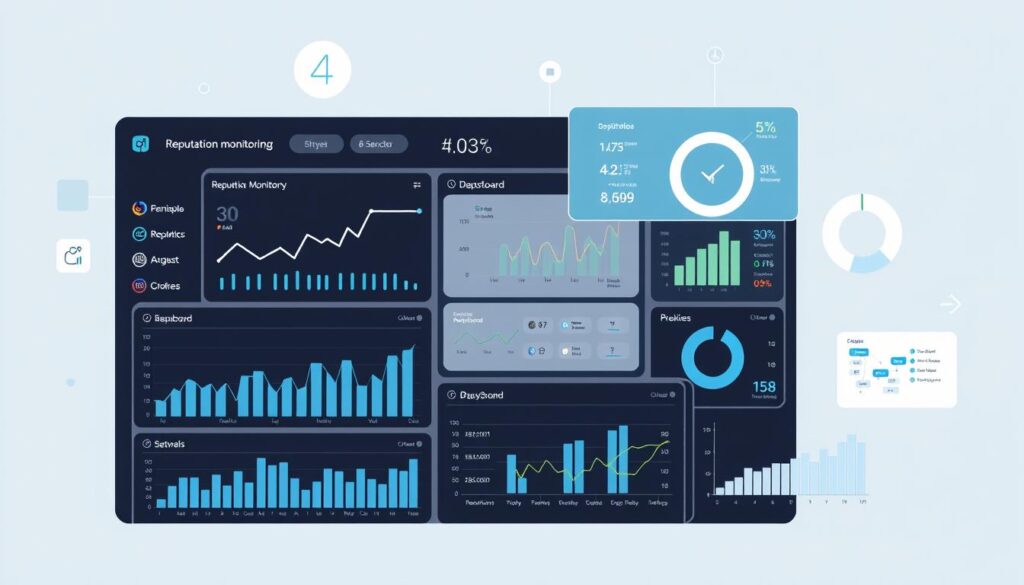
Reputation AI SEO tools have become essential for companies aiming to protect and enhance their online reputation. These advanced tools offer a range of capabilities that help businesses maintain a strong digital presence.
AI Reputation Monitoring and Analysis Features
AI-powered reputation monitoring tools enable businesses to track their online presence in real-time. These tools analyze vast amounts of data from various sources, including social media, review sites, and news outlets, to provide a comprehensive view of a company’s reputation.
Key features include:
- Sentiment analysis to gauge public opinion
- Real-time monitoring to quickly identify and address potential issues
- Predictive analytics to forecast future reputation trends
Voice of Brand and Response Alignment Technologies
Voice of Brand (VoB) technologies use AI-driven sentiment analysis to review customer responses, ensuring that tone, messaging, and sentiment align with brand guidelines. This protects trust and credibility across every customer touchpoint.
- Ensures consistency in how your business communicates across all digital touchpoints, maintaining brand integrity.
- Analyzes outgoing communications to ensure they match established brand voice, tone, and messaging guidelines.
- Automatically flags communications that deviate from brand standards before they reach customers.
- Provides pre-approved, brand-aligned templates that maintain consistency while allowing for personalization.
By leveraging these technologies, businesses can maintain a cohesive customer experience that builds trust and recognition, particularly valuable for companies with multiple locations or large customer service teams.
Implementing AI Reputation Management: Step-by-Step Approach
To effectively manage your online reputation, a step-by-step approach is necessary in the AI era. This involves understanding your current reputation status, setting up AI-powered monitoring systems, and developing response protocols and workflows.
Assessing Your Current Reputation Status
Begin by evaluating your current online reputation. This involves analyzing customer reviews, social media mentions, and search engine results to understand how your business is perceived online. Reputation Returns offers a free “Rep Radar Check” to help businesses assess their online reputation and compare it with competitors.
Setting Up AI-Powered Monitoring Systems
Next, implement AI-powered monitoring tools to track your online presence in real-time. These systems can analyze vast amounts of data quickly, providing insights into customer sentiment and emerging trends. Effective monitoring enables businesses to respond promptly to both positive and negative feedback.
| Monitoring Features | Benefits |
|---|---|
| Real-time tracking | Prompt response to customer feedback |
| Sentiment analysis | Understanding customer emotions and concerns |
| Trend identification | Proactive strategy development |
Developing Response Protocols and Workflows
Establishing clear response protocols and workflows is crucial for consistent reputation management. This includes defining response protocols for different scenarios, developing workflows for escalating issues, and training your team to handle various reputation-related tasks. By integrating AI-suggested responses with human oversight, businesses can create an efficient yet authentic engagement system.
- Establishing clear response protocols ensures consistent handling of reputation issues.
- Effective workflows define escalation paths for different types of reputation events.
- Response templates should be developed for common scenarios while allowing for personalization.
- Approval processes help maintain brand integrity while enabling timely engagement.
By following this step-by-step approach, businesses can effectively implement AI reputation management and protect their online presence.
Balancing AI Automation with Human Oversight
The integration of AI in reputation management necessitates a harmonious blend of technological efficiency and human judgment. While AI can dramatically improve efficiency by automating routine reputation management tasks, human oversight remains essential for strategy, context, and nuanced decision-making.
When AI Should Lead vs. When Human Intervention Is Critical
AI excels in processing large volumes of data quickly and accurately, making it ideal for tasks such as sentiment analysis and real-time monitoring. However, AI lacks the ability to fully understand complex, sensitive situations or evolving cultural dynamics. Human intervention is critical in these nuanced scenarios, where empathy, judgment, and strategic thinking are required.
For instance, in situations involving a brand’s crisis management, human oversight is indispensable. Humans can provide the necessary context and emotional intelligence to navigate these complex situations effectively.
Training AI to Align with Your Brand Voice
To ensure that AI-generated content aligns with your brand voice, it’s crucial to provide clear examples of approved communications that embody your desired tone and messaging. Voice of Brand technology can analyze existing content to identify the distinctive elements that define your brand’s communication style.
- Regular refinement of AI response parameters ensures that automated communications maintain brand consistency as your positioning evolves.
- Creating brand voice guidelines specifically for AI systems helps maintain consistency across all customer touchpoints.
- Human review of AI-generated content during the training phase helps identify areas where brand voice alignment needs improvement.
By combining AI’s efficiency with human strategic oversight, businesses can ensure that their reputation management is both effective and aligned with their brand values.
Case Studies: Successful Reputation AI SEO Implementations
Several businesses have seen substantial improvements in their reputation management through AI-driven SEO strategies. By leveraging advanced technologies, companies can now proactively address potential reputation issues and enhance their online presence. This section highlights two notable case studies that demonstrate the effectiveness of Reputation AI SEO implementation.
Enhancing Customer Engagement in Hospitality
A national hospitality brand struggled with inconsistent customer experiences across different locations, leading to reputation disparities and declining customer satisfaction. By implementing Reputation Return’s AI Reputation Manager (ARM), the brand was able to proactively monitor sentiment trends and identify emerging issues before they escalated.
- The AI system detected an emerging pattern of negative feedback regarding service quality.
- This early detection allowed the company to implement enhanced staff training programs.
- The proactive approach resulted in a significant improvement in customer satisfaction scores.
A Retail Chain's Success in Proactive Reputation Management
A major retail chain with over 500 locations faced challenges with inconsistent store experiences, leading to reputation disparities across markets and declining customer satisfaction. The company implemented ARM to proactively monitor sentiment trends and identify emerging issues.
Within weeks, the AI system detected rising negative sentiment around store cleanliness, allowing the company to take action before it impacted their reputation. This early detection enabled the retail chain to implement an enhanced cleaning protocol and staff training program, preventing an estimated 15% decline in customer satisfaction scores and preserving approximately $3.2 million in revenue.
The retail chain now relies on AI-driven reputation intelligence to guide operational decisions, marketing strategies, and customer experience initiatives, demonstrating the success of proactive reputation management through AI-driven SEO strategies.
The Future of Reputation Management in AI Search
The landscape of reputation management is on the cusp of a revolution, driven by advancements in AI-driven search. As we move forward, it’s essential to understand the emerging trends and prepare our businesses for the next generation of AI tools.
Emerging Trends in AI-Driven Search and Reputation
We anticipate several powerful AI-driven reputation management capabilities. One significant development is brand monitoring tools specifically designed to influence visibility within generative AI search results, such as Google’s AI Overviews. Another is AI-driven business intelligence layers that will integrate reputation data directly into corporate decision-making frameworks, enabling smarter, faster, and more strategic planning across the organization.
To stay competitive, companies should start implementing AI-powered solutions now. This involves establishing strong data governance practices to ensure reputation data is accurate, accessible, and actionable.
| Trend | Description | Impact on Business |
|---|---|---|
| AI-Driven Search Results | Increased reliance on AI for search result generation | Higher visibility for managed reputations |
| Brand Monitoring Tools | Advanced tools for tracking brand mentions in AI search | Better reputation management |
| AI Business Intelligence | Integration of reputation data into business decision-making | More informed strategic planning |
Preparing Your Business for Next-Generation AI Tools
To prepare, businesses should create a centralized reputation management strategy that can adapt to emerging AI capabilities. Investing in staff training on AI concepts and developing partnerships with forward-thinking reputation technology providers will also be crucial.
- Establish strong data governance practices.
- Create a flexible reputation management strategy.
- Invest in staff training on AI.
- Develop partnerships with innovative tech providers.
By taking these steps, businesses can ensure they’re ready for the future of AI-driven reputation management and poised to leverage new tools and technology as they emerge.
Common Challenges in Reputation AI SEO and How to Overcome Them
As businesses increasingly adopt AI for SEO, they face unique challenges that require strategic solutions. The integration of AI in reputation management and SEO is not without its obstacles, and understanding these challenges is crucial for success.
Addressing AI Biases and "Blackbox" Decision-Making
One of the significant challenges in Reputation AI SEO is dealing with AI biases and the “blackbox” nature of some AI decision-making processes. AI algorithms can sometimes perpetuate existing biases if they are trained on biased data, leading to skewed results that may not accurately reflect a brand’s true reputation. To overcome this, businesses must ensure that their AI systems are trained on diverse and representative data sets. Additionally, implementing transparent AI processes can help in understanding how decisions are made, allowing for more effective management of reputation.
Regular audits and testing of AI systems for bias are essential. By doing so, businesses can identify and rectify any issues before they significantly impact their reputation management efforts.
Maintaining Content Originality While Leveraging AI
Another challenge is maintaining content originality while leveraging AI for content creation. Search engines like Google prioritize unique, high-quality content, and relying solely on AI-generated content can lead to generic or repetitive material that may not rank well. To address this, businesses should adopt a hybrid approach where AI assists with research and structure, while human writers add unique insights, examples, and brand voice.
- Implementing content differentiation strategies, such as incorporating proprietary data or exclusive expert perspectives, can help maintain distinctiveness.
- Regular content audits are crucial to ensure that AI-assisted content meets quality standards and supports reputation goals.
By combining the strengths of AI with human creativity and oversight, businesses can create high-quality, original content that enhances their SEO performance and supports their reputation management objectives.
How Reputation Returns Ensures AI SEO Success

At Reputation Returns, we understand that achieving AI SEO success is crucial for your business in today’s competitive digital landscape. Our comprehensive solutions are designed to protect and enhance your online reputation, ensuring maximum visibility in AI-driven search results.
Comprehensive AI Reputation Management Solutions
Our team provides expert reputation management services tailored to your specific business needs. We utilize advanced tools to monitor and analyze your online presence, identifying areas for improvement and opportunities for growth.
The Rep Radar Check: Safeguarding Your Digital Brand
Our exclusive Rep Radar Check offers a free assessment of your current digital reputation status and AI search visibility. This diagnostic tool evaluates your business across multiple reputation dimensions, including review sentiment, response rates, and competitive positioning.
- Comprehensive evaluation of your digital reputation status and AI search visibility
- Identification of specific reputation vulnerabilities that could be limiting your visibility in AI-driven search results
- Actionable recommendations prioritized by potential business impact and implementation difficulty
- Competitive comparison feature to show how your reputation metrics stack up against industry leaders and direct competitors
By leveraging our Rep Radar Check, you can gain valuable insights into your online reputation and take proactive steps to enhance your digital brand protection.
Measuring Success: Key Metrics for Reputation AI SEO
Evaluating the performance of your Reputation AI SEO requires a comprehensive approach that includes various metrics and indicators. To determine the effectiveness of your AI-driven reputation management, you need to track key performance metrics that reflect your online reputation and search visibility.
Tracking Sentiment Trends and Brand Perception
Monitoring sentiment trends is crucial for understanding how your brand is perceived online. We analyze customer feedback, reviews, and social media conversations to gauge the overall sentiment around your brand. This helps us identify areas for improvement and measure the impact of our reputation management efforts.
Monitoring Search Visibility and Conversion Metrics
Search visibility metrics, such as featured snippet appearances and knowledge panel presence, are essential for evaluating your online reputation. We also track conversion metrics, including click-through rates, direction requests, and phone calls, to connect reputation improvements to business outcomes.
| Metric | Description | Importance |
|---|---|---|
| Search Visibility | Tracks how frequently your business appears in AI-driven search results | High |
| Conversion Metrics | Connects reputation improvements to business outcomes | High |
| Sentiment Analysis | Gauges the overall sentiment around your brand | Medium |
Conclusion: Taking Action on Your Reputation AI SEO Strategy
As we navigate the evolving AI search landscape, a strong reputation AI SEO strategy is vital. Businesses that prioritize reputation management will gain significant competitive advantages in visibility and customer trust.
To begin taking action on your reputation AI SEO strategy, start with a comprehensive assessment of your current reputation status using tools like Reputation Return’s free Rep Radar Check. This step is crucial for understanding your current standing and identifying areas for improvement.
Implementing AI-powered reputation management solutions enables your business to scale reputation efforts efficiently while maintaining authenticity and brand consistency. The integration of reputation management with SEO is no longer optional—it’s essential for visibility in today’s AI-driven search landscape.
Don’t delay; businesses that fail to implement reputation AI SEO strategies risk declining visibility as search algorithms increasingly prioritize reputation signals. Reputation Return provides the expertise, tools, and support needed to navigate this complex landscape and ensure your business thrives in AI search environments.
Schedule your free consultation today to discover how our reputation AI SEO solutions can transform your digital presence and drive measurable success in the future.
FAQ
What is Reputation AI SEO, and how does it differ from traditional SEO?
We define Reputation AI SEO as the integration of artificial intelligence into search engine optimization to enhance brand visibility and protect online reputation. Unlike traditional SEO, Reputation AI SEO leverages AI-driven insights to analyze customer feedback, sentiment trends, and brand perception, enabling businesses to make informed decisions.
How does AI analyze a brand’s online reputation?
We utilize AI-powered tools that employ sentiment analysis and natural language processing to assess customer reviews, feedback, and online mentions. These tools help us understand the nuances of customer sentiment, allowing us to identify areas for improvement and develop targeted strategies to enhance brand reputation.
What role do customer reviews play in Reputation AI SEO?
We recognize that customer reviews significantly impact Reputation AI SEO. AI interprets and weighs customer feedback, providing valuable insights into brand perception. By generating and managing positive reviews, businesses can improve their online reputation and increase search visibility.
How can businesses implement AI Reputation Management effectively?
We recommend a step-by-step approach, starting with assessing your current reputation status using our free Rep Radar check. Then, we help you set up AI-powered monitoring systems, develop response protocols, and establish workflows to ensure timely and effective responses to customer feedback.
What are the key benefits of using AI Reputation Management for multi-location businesses?
We have seen that AI Reputation Management provides measurable benefits for multi-location businesses, including improved customer engagement, cost savings, and efficiency gains through automation. By leveraging AI-driven insights, businesses can make data-driven decisions and enhance their overall brand reputation.
How do you balance AI automation with human oversight in Reputation Management?
We believe in striking a balance between AI automation and human oversight. While AI leads in data analysis and monitoring, human intervention is critical in responding to customer feedback and making strategic decisions. We train our AI tools to align with your brand voice, ensuring consistency and empathy in customer interactions.
What are the essential capabilities of Reputation AI SEO tools?
We look for AI Reputation Monitoring and Analysis Features, as well as Voice of Brand and Response Alignment Technologies, in Reputation AI SEO tools. These capabilities enable businesses to track sentiment trends, monitor search visibility, and respond effectively to customer feedback.
How can businesses prepare for the future of Reputation Management in AI Search?
We advise businesses to stay informed about emerging trends in AI-driven search and reputation management. By leveraging next-generation AI tools and strategies, businesses can proactively manage their online reputation and stay ahead of the competition.