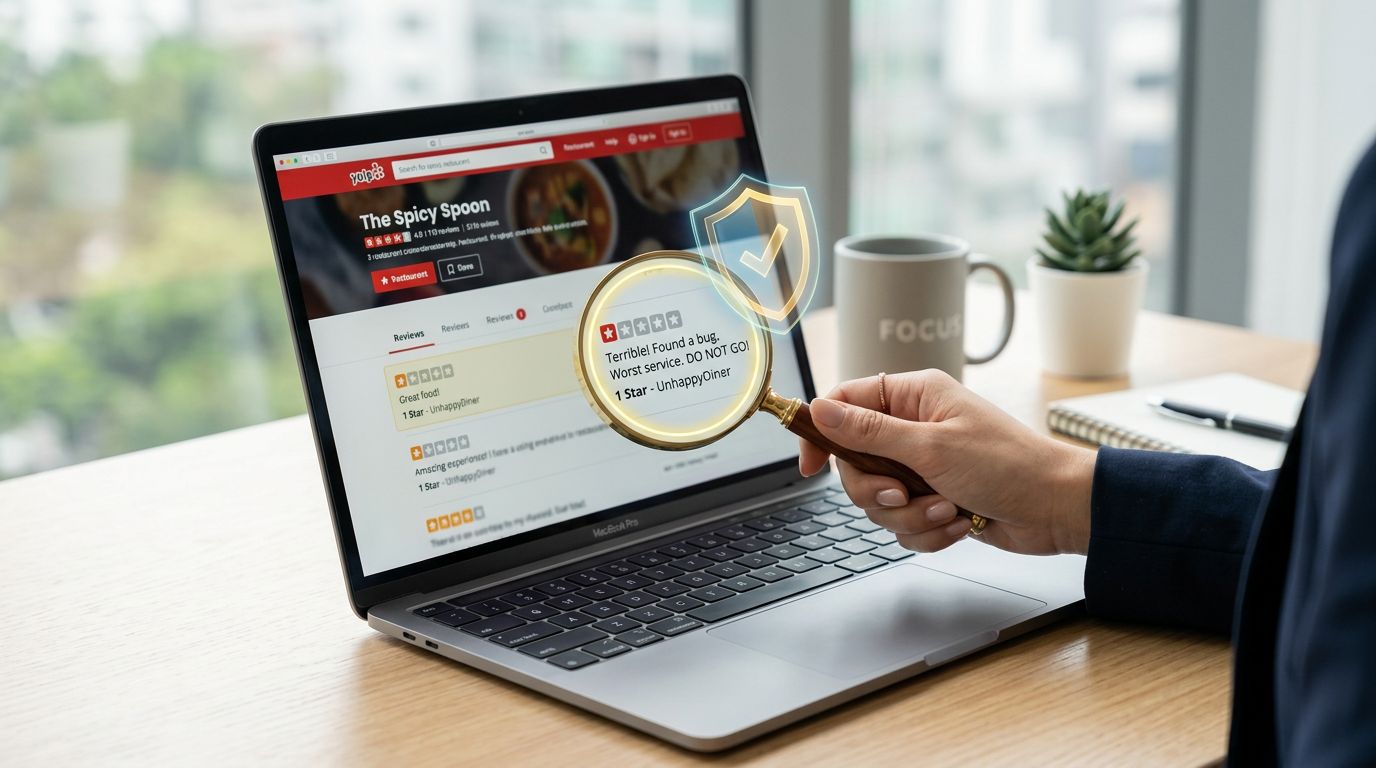

A fake Yelp review can feel like graffiti on your front door. It’s public, it’s unfair, and it can scare away the next customer before you ever get a chance to speak. The key is to remove fake Yelp reviews effectively while protecting your reputation.
The goal isn’t to “win an argument” online. It’s to remove fake Yelp reviews the right way, while staying inside Yelp’s rules so you don’t trigger consumer alerts or other penalties.
Below is a practical, step-by-step approach that works for business owners, doctors, attorneys, and anyone whose online presence is tied to client trust.
What Yelp may remove (and what it usually won’t)
Yelp doesn’t remove reviews just because they’re negative or because you disagree. Instead, removal usually happens when a review breaks the Yelp content guidelines, for example conflict of interest, harassment, hate speech, threats, or sharing private info.
Start by reading Yelp’s standards so your report uses Yelp’s language, not just your frustration. Keep these open while you work:
Before attempting any removals, claim your business page to access full management tools.
Here’s the key mindset: Yelp is not judging whether the reviewer is “right.” Yelp’s recommendation software works to filter content that violates guidelines (or involves problematic reviewer relationships).
Also, avoid common self-inflicted damage. Yelp can penalize businesses for review manipulation behaviors, including:
- review gating (only asking happy customers)
- incentives or discounts for reviews
- bulk review requests right after a campaign
- employee, family, vendor, or competitor reviews
- paid reviews, fake review scams, or hiring someone to post them (all subject to FTC ban)
- harassing, doxxing, or threatening reviewers
If you try to fix one fake review by bending the rules, you can end up with a bigger problem than the review itself.
If you want the bigger picture of why review issues spread fast in 2026, see Why Online Reputation Management Matters in 2026.
Step-by-step: document, flag, and follow up the right way
Before you flag anything, collect clean evidence. You’re building a short, factual case that a human moderator can verify quickly.
Evidence checklist (keep it tight and specific)
- Review URL and screenshot (capture date/time)
- Reviewer profile screenshot (name, photo, history if visible)
- Transaction check: Check business records for the name, date range, service type, location
- Staff notes: who was working, what happened, whether anyone matches the story
- Violation reasons: which guideline is violated (conflict of interest, harassment, privacy, etc.)
- Related messages: any extortion attempt (for example, “refund or I’ll post”)
Next, report review inside Yelp using the official flow: find the three dots menu and click the flag icon so it’s tied to the review and your Yelp business account.
When you write the report, use a simple structure:
- One sentence summary of the violation
- Two to four bullets with evidence
- A short closing offering to provide more details
Don’t add emotional language, accusations, or threats. Moderators respond to clarity.
Sample internal log for suspected fake Yelp reviews
Use a lightweight log so your team stays consistent.
| Date logged | Review date | Reviewer handle | Star rating | Suspected issue | Evidence captured | Action taken | Status |
|---|---|---|---|---|---|---|---|
| 2026-03-03 | 2026-03-02 | “J.S.” | 1 | No matching customer, possible competitor | Screenshot, CRM search note | Report review in Yelp, documented | Pending |
| 2026-03-03 | 2026-03-01 | “Maya K.” | 1 | Mentions staff by wrong name, wrong location | Screenshot, schedule match | Public response posted | Pending |
| 2026-03-03 | 2026-02-28 | “T.B.” | 2 | Contains private info | Screenshot with redaction note | Flagged for privacy | Pending |
Finally, set expectations. To report review doesn’t guarantee removal, and human moderators will eventually evaluate the claim. Yelp may take time to review. Meanwhile, your best move is a calm public response (next section) and steady, compliant reputation management.
Public responses that protect you (without poking the bear)
Even if you plan to remove fake negative Yelp reviews, you still need to respond publicly to manage what future readers see today. A good response is short, polite, and written for the silent audience, not the reviewer.
One caution: don’t reveal private details (especially for medical, legal, or personal services). Don’t argue point-by-point. Don’t accuse them of lying. Keep it boring.
If you want more examples of tone and structure for handling negative Yelp reviews, SpotOn has a helpful guide: negative Yelp response templates.
Here are examples of a professional response:
Template 1 (suspected fake review, no policy claim)
Hi [Name], we take feedback seriously, but we can’t locate a record of your visit or any personal customer experience based on the details provided. Please message us through Yelp with the date and service so we can look into it and try to help.
Template 2 (policy-violating content, stay neutral)
Thanks for sharing your perspective. We’ve reported this review to Yelp because it appears to include information that may not meet Yelp’s guidelines. If you have a real concern, please contact us privately so we can address it.
Template 3 (legitimate negative, service recovery)
Thanks for the feedback, and I’m sorry this didn’t meet expectations. If you message us with the date of your visit, we’ll review what happened and work toward a fair resolution.
If the review crosses into “false or defamatory” claims, read Yelp’s position first: Will Yelp remove a false or defamatory review?
Stay compliant while you rebuild trust (and when to escalate)
The safest long-term plan is simple: keep service strong, keep your documentation tight, and avoid any review behavior that looks coordinated.
Here’s a quick do and don’t table your team can follow when managing customer feedback.
| Do | Don’t |
|---|---|
| Report only clear guideline violations | Offer discounts, gifts, or refunds for reviews |
| Respond calmly, without private details, while upholding privacy standards | Ask employees, family, partners, competitors, or ex-employees to post reviews |
| Track suspected fakes in an internal log | Run bulk review “blasts” after a dispute |
| Invite unhappy customers to contact you privately | Harass, threaten, or shame reviewers |
If you’re dealing with fake review spam, such as repeated fake reviews, competitor attacks, or a pattern that spills into search results, it may be time for online reputation repair, not just review cleanup. That’s where online reputation management becomes a system, not a scramble. A strong plan can include monitoring, response support, and broader content strategies that reduce the impact of bad listings over time.
For a plain-English overview, see What Is Online Reputation Management (ORM)?. Many businesses also choose reputation management services from a company (or compare online reputation management companies) when they need consistent process and documentation. In higher-risk cases, a Reputation Repair Company or Online Reputation Expert can coordinate Reputation Repair Services across multiple platforms, not just Yelp.
When to talk to an attorney (not legal advice)
Consider a qualified attorney if you see:
- Defamation with identifiable false statements presented as fact
- Extortion (money, free services, or threats tied to removing a review)
- Harassment or stalking, especially if it targets staff or family
- Impersonation or coordinated competitor campaigns
A lawyer can advise on preservation, formal notices, and next steps without escalating the situation in public.
Conclusion
Fake reviews are frustrating, but panic is what gets businesses penalized. Document the issue, report it using Yelp’s rules, and respond in a way that reassures future customers. Over time, steady online reputation management and disciplined processes do more than remove fake Yelp reviews; they protect the trust your business depends on while nurturing genuine customer testimonials for long-term growth.