
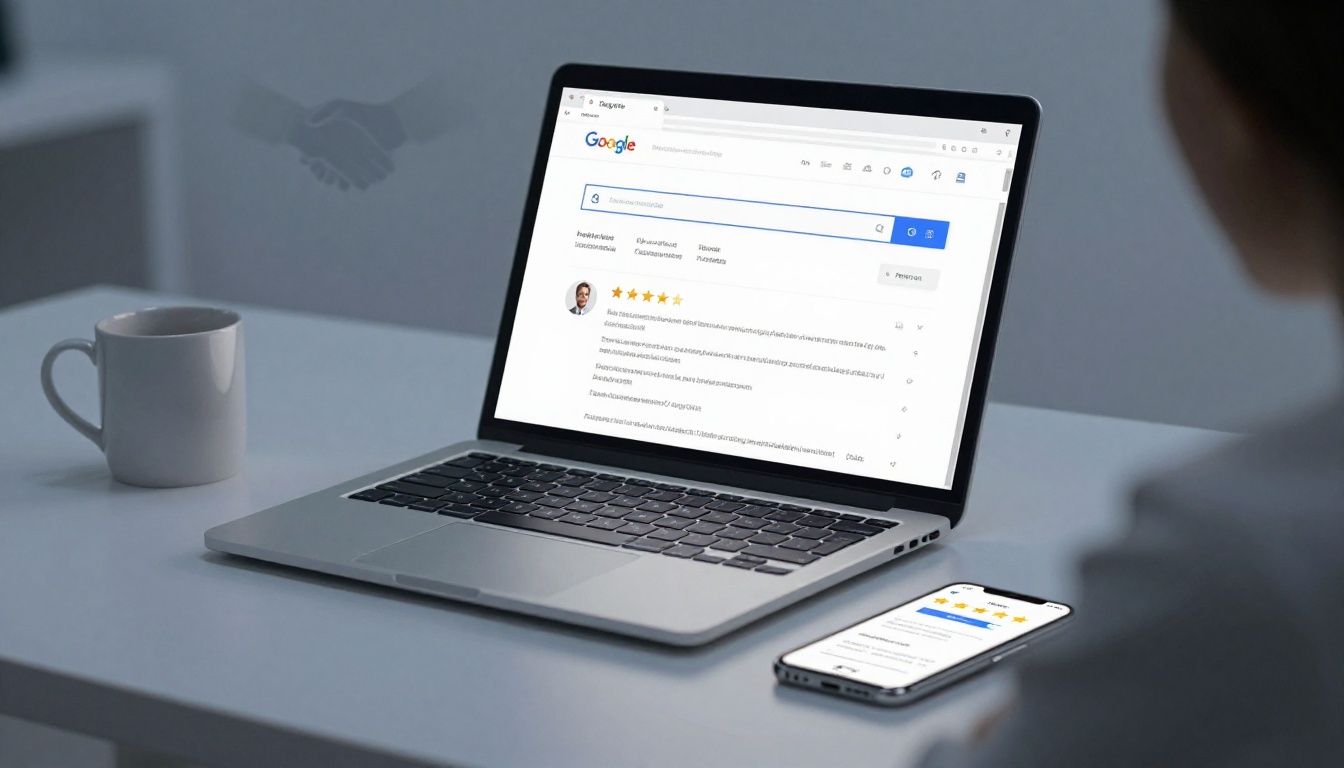

The “handshake” used to happen in a lobby, at a conference table, or over a coffee. In February 2026, it often happens on Google.
A prospect sees your ad, gets your name from a referral, or hears you speak on a panel. Then they do what people do now, they check. In quick bursts, they scan your Search Engine Results, reviews, and a few third-party mentions to decide if you’re credible, safe, and worth their time.
If those results feel off, sales don’t always fail loudly. They fail quietly. Leads get colder, booked calls turn into no-shows, and “we’ll get back to you” becomes a dead end. This post shows how to spot reputation leaks in your pipeline’s digital narrative, how the build, protect, repair framework works, and a practical 30-day plan for business owners, doctors, lawyers, CEOs, and public figures to drive business growth.
The moment prospects Google you is the real first sales meeting
Prospects don’t research like they’re writing a report. They research like they’re checking the weather. Fast, casual, and decisive.
It usually happens right after a trigger:
- They click an ad and want to make sure you’re real.
- A friend recommends you and they want to confirm the recommendation.
- They meet you at an event and want to verify the story you told.
- They get your proposal and want to see if others trust you.
That’s why first impressions stick. Your “second impression” often happens on the search results page, not in your inbox.
When someone Googles you, they’re not just looking at your website. They’re scanning a whole shelf of signals: organic Google results, your Google Business Profile (for local businesses and practices), online reviews on platforms like Google and Yelp, social profiles, directory listings with additional online reviews, podcast or press pages, and the “People also ask” boxes that can frame your name in a way you didn’t choose. Research on how modern search pages, shaped by search engine optimization, pull attention shows that these extra components can influence what people click and notice first, not just the classic blue links, see Stanford’s study on SERP components and attention.
Marketing is what you say, branding is what others say about you
Digital marketing is your message: your ads, your pitch deck, your website copy, your talk track.
Branding is the echo, shaping your brand image and public perception: reviews, Reddit threads, directory blurbs, articles written by someone else, and social comments you don’t control. In simple terms, digital marketing is the promise, branding is the proof people think they found.
That gap hits conversions in ways that are easy to miss:
- Your cost per lead rises because more people bounce after they click.
- Reply rates drop because your email signature sends them to a messy search page.
- Booked calls shrink because a spouse, assistant, or partner did a quick check.
- Price pressure increases because customer trust is low, so they “shop” harder.
In B2B, this effect is even stronger because buyers are risk-averse and cross-check sources. For a recent snapshot of how buyers use social media signals while researching, see Forrester on social media in B2B buying.
Where deals die: when your online story does not match your pitch
If you’re great in person but inconsistent online, prospects experience a jolt. It’s like watching someone crush a live presentation, then going home and finding a dated, confusing website and a handful of alarming reviews. The brain hates mismatch. It reads as risk, eroding customer trust before you even start.
Common mismatches that quietly kill deals include:
- Your pitch says “specialist,” but your site reads like a generalist brochure.
- Your bio is outdated, or your headshot looks 10 years old.
- Your services page doesn’t match what you said on the call.
- Your niche positioning changes across platforms (doctor, executive coach, “consultant,” speaker).
- Your social proof is thin, scattered, or inconsistent (no case stories, no credible mentions).
If you want a deeper explanation of what online reputation management includes and why it affects real decisions, this guide on online reputation management (ORM) breaks it down clearly: what online reputation management (ORM) means.
Build, protect, repair: the 3 reputation moves that keep revenue steady
Online Reputation Management is easiest to understand with a simple frame: build, protect, repair. You might need one, two, or all three, depending on what already shows up on page 1 of Google.
Each pillar has a clear goal: make page 1 accurate, credible, and aligned with what you actually do. These form the core pillars of Online Reputation Management.
Success doesn’t mean “everyone loves you.” It means a reasonable prospect can verify you quickly and feel confident moving forward. And waiting until you need repair is usually the most expensive option, in time, stress, and lost opportunities. If you’re curious what’s changed and what’s at stake right now, this internal breakdown is worth reading: Why You Need Online Reputation Management in 2026.
Build (for the “ghost”): create a strong, accurate footprint from scratch
Some professionals have a surprising problem: not a bad reputation, but an empty one. If your search results are thin, Google fills the space with whatever it finds first, which can be low-quality directories, irrelevant mentions, or someone else with a similar name.
Building is about creating an online footprint that matches your real-world credibility:
- Owned assets like a well-built website, a leadership bio, and clear service pages that explain outcomes in plain language.
- Consistent profiles across LinkedIn, major directories, and industry sites, with the same niche, title, and location details.
- Credible third-party signals like media features, speaking pages, publications, or associations on high-authority sites that help Google understand you.
For many executives and public-facing pros, personal reputation and the business brand should both exist. They shouldn’t be identical, but they should support each other. If you are the face of the firm, your personal reputation needs to stand on its own.
Protect (for the “sandcastle”): add stability before the next wave hits
If you already have solid reviews and good press, protection is how you keep one bad week from becoming your top search result for the next two years.
Protection is mostly unglamorous work that pays off later:
- Monitor brand mentions so you’re not surprised by a new thread or review spike.
- Keep your key pages and profiles updated, especially leadership bios, offers, and contact info.
- Build a buffer of relevant, positive content that can hold page 1 if something negative appears.
- Create a steady and ethical strategy for online reviews, so your profile doesn’t look stale.
Local businesses and practices should treat their Google Business Profile like a front desk. Even small improvements can change how often you show up and how confident people feel when they see you, this overview of Google Business Profile optimization basics is a practical starting point.
Repair (when it is already public): stop the bleeding, then rebuild trust
Repair starts with one rule: don’t panic and start swinging. That usually makes things worse. Crisis management for public issues requires a measured approach.
An ethical repair approach looks like this:
- Assess what ranks and why (the query, the page type, backlinks, recency, and whether the issue is spreading).
- Address the root cause if the criticism is valid. Fixing the real problem improves outcomes and future reviews.
- Respond correctly where responses matter (calm, brief, professional, and privacy-safe for doctors and lawyers).
- Escalate legal issues carefully when content crosses the line into defamation, impersonation, or privacy violations, potentially pursuing content removal.
- Publish stronger assets that can outrank or offset negative content over time.
The goal isn’t “deleting the internet.” The goal is building enough trusted, accurate content that one negative result stops controlling the narrative. If you need help with that process, start here: Online Reputation Repair Services.
The trust triangle that drives sales: person, company, and product must all feel safe
Most sales advice focuses on the salesperson. Be likable. Be sharp. Follow up.
But buyers don’t only assess you. They assess a triangle: the person, the company, and the offer. If any corner feels unsafe, the deal slows down or dies.
Here’s what prospects are really asking, often without saying it:
- “Does it work?” (proof, competence, track record)
- “Can it help me?” (fit, relevance, empathy, outcomes)
Reputation signals answer these questions before your call starts. User-generated content like reviews, search results, and third-party mentions act like a silent reference check informed by customer feedback. If the references look messy, the buyer becomes cautious. Cautious buyers ask for discounts, extra guarantees, more meetings, and more time. That’s the real cost of overlooked customer feedback.
A quick self-audit: what shows up for your name, your company, and your offer
You can do a useful reputation monitoring audit in 15 to 30 minutes. Don’t overthink it. You’re looking for patterns.
- Search your full name in an incognito window (and common variations).
- Search your company name plus “reviews” to uncover brand mentions.
- Search your company name plus “complaints,” “scam,” and “lawsuit” (even if you think it’s ridiculous).
- Search your core service plus your city (for local practices and offices).
- Check Google Images for your name and brand.
- Check the map pack if you serve a region.
Document what you see: screenshots, the top 10 results, review themes via social listening, and anything that feels inconsistent with your real positioning. Prioritize fixes based on two things: what ranks highest, and what creates the strongest emotional reaction through sentiment analysis.
Omnipresence without noise: distribute content where your clients actually look
“Be everywhere” is bad advice if it means posting daily on six platforms and burning out. Omnipresence should feel calm, not chaotic.
Photo by Walls.io
A simple distribution plan works better:
- Pick 2 to 3 channels your buyers already use (for many, it’s Google, social media like LinkedIn, and one review platform).
- Publish one strong piece of proof each week (a case story, FAQ, credential explainer, or media mention).
- Repurpose it into smaller pieces that point back to the main asset.
The difference between a one-time PR spike and durable reputation assets is staying power. Durable assets keep ranking because they are clear, useful, and well-structured. SEO and optimization are the underwater part of the iceberg that keeps good content visible for strong online visibility. Reputation monitoring ensures your efforts maintain that edge. If you run ads, it’s also smart to understand how small psychology cues shape clicks and decisions, Google’s own write-up on behavioral biases in search ads is a helpful read.
A simple 30-day reputation plan to protect your pipeline
You don’t need a full rebrand to stop reputation leaks. You need a focused month where your public story becomes consistent.
Week 1: control the basics buyers check first
Start with what prospects see in the first 30 seconds.
Claim and update your key profiles (Google Business Profile, major review sites, directories, LinkedIn), then fix inconsistent business info (name, address, phone, categories). Refresh bios and headshots so they look current and match your role. This lays the groundwork for online reputation management.
If you find negative Google Reviews, respond with discipline:
- Be professional and brief.
- Acknowledge the feeling, don’t argue details in public.
- Invite offline resolution.
- For doctors and lawyers, protect privacy at all costs.
If you’re a company leader, align your leadership bio with your company’s positioning. If those conflict, people assume the worst.
Weeks 2 and 3: publish proof that you deliver results
Now you’re building the proof layer that buyers crave.
Publish positive content that answers doubts and shows outcomes without oversharing:
- A few short case stories (no sensitive details, just the problem, approach, and result).
- An FAQ page that handles the hard questions you hear in sales calls.
- Credential and process pages (what makes your work reliable).
- Clear service pages that match what you pitch.
Consistency is the point. You want the “second impression” (search results, favored by the search algorithm) to confirm the first (your call, talk, or referral), not contradict it.
If you’re running a company, this is also where structured support helps. Reputation work crosses marketing, PR, and sometimes legal. For business-focused online reputation management support, this page explains what that can look like: Business Reputation Management Services.
Week 4: set up monitoring and a crisis playbook so you are not surprised
Reputation problems feel sudden, but they often start small. Monitoring keeps small things small.
Use reputation management tools to track:
- Brand mentions (name and company) with real-time alerts
- New reviews and rating changes
- Search page changes for your priority terms
Assign ownership. Decide who responds, who approves, and how fast you respond. Set rules for high-risk situations: legal threats, false claims, client or patient privacy, employee issues, and impersonation accounts. Reputation management tools make this ongoing process efficient.
If you’re considering outside help, choose carefully. This industry has real talent and real scams. Use a checklist before signing anything, including deliverables, timelines, and ethical boundaries: How to Choose the Right Online Reputation Management Company.
Conclusion
Reputation isn’t a vanity project. It’s a revenue asset. If you ignore it, you hand control to algorithms and strangers, then you pay for it in slower pipelines, lost trust, and reduced customer satisfaction.
Pick your starting point (build, protect, or repair), run the self-audit, and fix the biggest trust leak first. Mastering online reputation management lets you control your narrative for long-term brand awareness. If you want a partner, Reputation Rhino brings a multidisciplinary team across legal, PR, marketing, and technology, and has been recognized by outlets like Bloomberg Businessweek, Forbes, Newsweek, and U.S. News, plus inclusion on the 2025 Inc. 5000 list for our strong brand image. Start by checking what page 1 says about you today, including social media, then make sure it matches the reputation you’re earning offline.