

Opinions expressed by Entrepreneur contributors are their own.
Key Takeaways
- Show up in people’s lives before they need you, and customers and talented hires will come to you.
- Prove a single location works before you open a second one.
- Letting go of perfect is what lets a business grow.
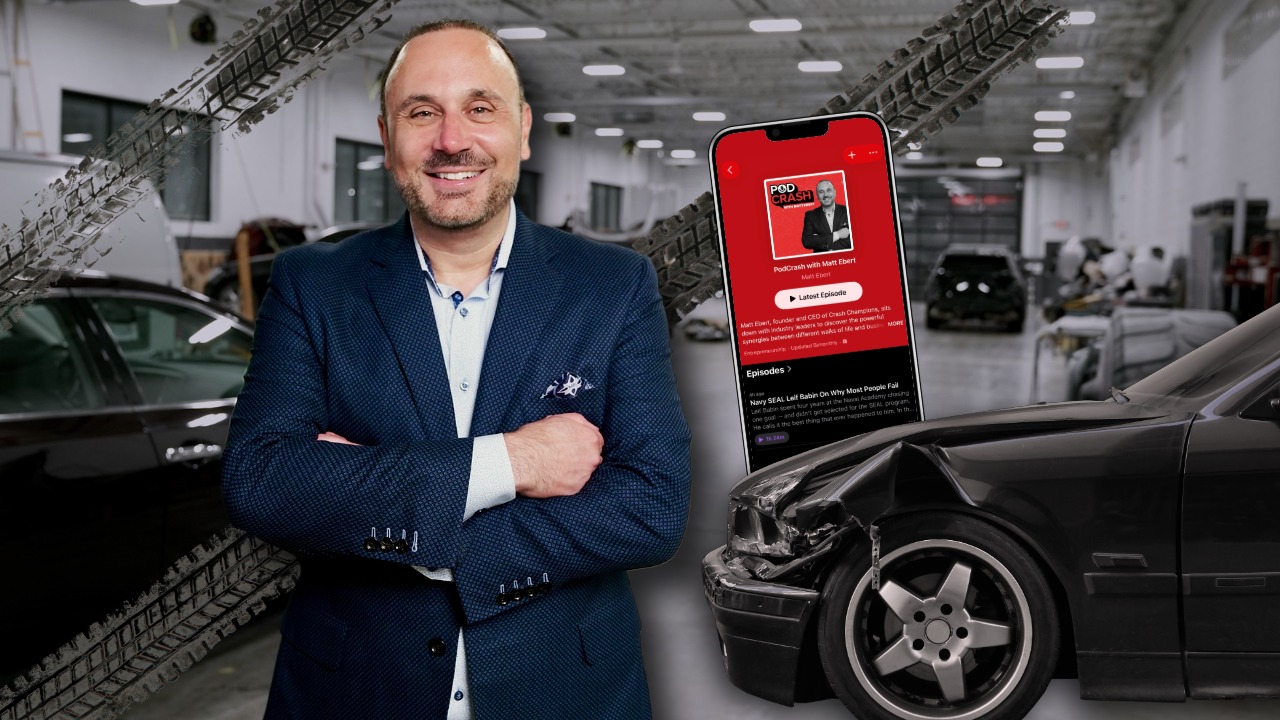
Running 650 collision repair locations would seem to leave little time for hosting a podcast, especially one whose return Matt Ebert can’t put on a spreadsheet.
But Ebert has found reasons to keep recording.
The Crash Champions leader explained why podcasting has become part of how he builds relationships with customers and potential employees.
“Unless you have an accident, you don’t care about us,” Ebert says. “Then if you do have an accident, then you wish you knew us.”
That creates a difficult marketing challenge. A customer might need the company only once every 10 years. Through PodCrash with Matt Ebert, he gives people a chance to hear from him before that moment arrives.
“It’s a business where trust really matters,” Ebert says. “So the way to build trust is to get to know somebody.”
Ebert started by seeking invitations to other podcasts. Launching his own show gave him a way to host conversations about leadership, entrepreneurship and blue-collar trades. Guests with larger audiences could introduce new people to the business, even if only a handful followed after each interview.
After about 35 episodes, Ebert still couldn’t put a precise return on a spreadsheet. But he could point to an unexpected benefit: recruiting.
“The people interviewing with us feel like they know me,” he says.
Those conversations also let Ebert challenge perceptions of collision repair work. He says the company’s technicians earn an average of more than $100,000 annually, and today’s advanced vehicles mean they’re as likely to hold a tablet as a welder or paint gun.
For Ebert, the show gives customers and potential employees a clearer picture of the people behind the business. When they eventually need a repair or consider a job, they have something more to go on than a company name.
Growth requires trust
Earlier in his career, Ebert tried his hand at the restaurant business as a Subway franchisee in his 20s. His first location wasn’t making much money, but he thought a second would improve things.
It didn’t.
“I thought getting two that don’t make much money was gonna be a great idea,” Ebert says. “It didn’t work that way.”
The experience taught him something he would later apply to collision repair: Expansion needs a profitable business underneath it.
“Before you can scale a business, you need to be able to show that there’s a demand for the product, and that you can do it profitably,” Ebert says.
For years, Ebert operated one repair shop with a partner. He bought out that partner in 2014 and began growing. A private equity investment followed in 2019, when the company finished the year with 13 locations.
Capital helped fund the expansion, but choosing a partner required honest conversations about how to grow and where both sides wanted the company to be in five years.
Running more locations also required him to change.
“It takes people, and you have to trust people,” Ebert says. “Otherwise, it won’t work.”
That meant accepting work that reached 95% of what he could accomplish himself.
“There’s no way you can scale if you’re gonna demand everything be perfect,” he says.
Ebert once obsessed over a single burned-out light bulb. With 650 locations, he jokes that there are probably 1,000 out at any given moment.
Ebert once wanted one shop and enough money to cash his paycheck. Now, he wants Crash Champions to become the largest collision repair company in the country.
“I never dreamed this big until recently,” he says.
Getting there requires trusting people to run the locations he cannot personally oversee. The burned-out light bulb can’t be what stops him from opening the next shop.
About Restaurant Influencers
Restaurant Influencers is brought to you by Toast, the powerful restaurant point-of-sale and management system that helps restaurants improve operations, increase sales and create a better guest experience. Toast — Powering Successful Restaurants. Learn more about Toast.
Restaurant Influencers is proud to have PepsiCo as a sponsor of this episode. Partnering with PepsiCo Foodservice helps restaurant operators drive sustainable growth through smarter digital experiences, AI-backed menu optimization, and tools designed to create more profitable online orders. Check out PepsiCo Foodservice