

Look, I know you’re probably not gonna believe this: people now regrow their hair with lasers.
Not even surgery or chemicals. Lasers. And the wild thing is it’s FDA-cleared. It is safe for men and women, and it actually works.
In 2025, non-surgical hair thinning solutions are evolving really quickly. With Laser Phototherapy (LPT) devices that are FDA-cleared, improved topical treatments and more rigorous clinical trial data, we now have safer and more effective drug-free options for androgenetic hair loss.
So, all you have to do is use the right device consistently, know what to expect, and always check for red flags. Emphasis on ‘Always.’

Why Non-Surgical Hair Solutions Have Become More Popular
Just think about it for a second:
Hair loss used to mean two choices in the past. You either take drugs every single day or drop thousands on surgery. And to be honest, that’s not exactly appealing.
But now, we’ve got a third FDA-cleared (non-surgical) that wouldn’t ruin your schedule or wreck your body.
So, What Is Low-Level Light Therapy (LLLT)?
LLLT is literally what it sounds like: low-level light (red or near-infrared) aimed at your scalp. But we don’t mean flashlight here. It is photobiomodulation. Let’s just say: “light energy charging up your cells.”
But how does that happen?
Simply, light hits your mitochondria (those are the tiny power plants in your cells). Then they pump out more ATP (energy), your hair follicles repair themselves better, and oxidative stress goes down.
We won’t bore you with the science. So, let’s just say your follicles get a wake-up call instead of a slow fade-out.
Yes, this sounds all good and smooth. But remember, not all devices are the same. The wavelength, source of light, treatment design all matter. But one thing is certain: lasers always win.
How Laser Phototherapy Sparks Hair Regrowth
It all starts with red light penetrating your scalp and lighting up the mitochondria inside follicle cells. And boom! More energy, More repair.
Then, follicles hang out longer in the anagen phase instead of shedding early. So, that means more of your stays put.
Also, the dermal papilla (we call it the follicle’s command center) fires back up. And suddenly, rather few strands look fuller again.

Where Does Laser Therapy Fit with Other Hair Regrowth Options?
Laser therapy isn’t actually sitting alone in the ‘hair-regrowth ring’. It’s got many other contenders, and in many ways, outpacing them.
LPT emerged as the absolute top performer among non-surgical treatments for androgenetic alopecia in many comparative reviews.
In fact, a meta-analysis found that LPT gave the largest mean hair-count increase of all options evaluated. And that includes minoxidil, finasteride, and PRP. (Gupta et al., 2018)
Also according to data, LPT and 5% minoxidil produced similar efficacy for regrowth in men and women.
And that’s not all.
Lasers also deliver growth with much fewer daily hasslesw hen compared to topicals like minoxidil. And compared to expensive clinic-based treatments (like PRP), lasers offer much more comfort and greater convenience.
From a cost-perspective (and this is very very important)… while one-time device cost of laser helmets may be higher, the elimination of daily drug purchases or repeated PRP clinic visits often makes LPT cheaper in the long run. I mean, you’ve got fewer side-effects, less downtime, fewer ongoing appointments.
The LPT Device Everyone’s Talking About
Yes, Theradome is a sleek helmet now doing rounds on Instagram. But before now, it was a vision by Tamim Hamid, who once helped design laser systems for space shuttle thermal protection.
He decided that the same precision should help people too, not just rockets. After struggling himself with hair thinning, he launched Theradome in 2013 via Indiegogo. He brought a wearable LPT device into homes. And dare we say that its journey from NASA tech to FDA-cleared device (for both men and women) is as much about engineering grit as it is about hair regrowth.
Because Theradome is one of the very few FDA-cleared helmets designed for both men and women with androgenetic alopecia.
Theradome: The Right Choice in Laser Phototherapy Devices
Yes, the market is flooded with look-alike gadgets. But let’s be honest: not every helmet flashing red lights deserves your money.
Of course some are quite impressive. But some are just glorified Christmas decorations (if we’re being polite).
So how do you know you’re getting the real thing? How do you know you’re getting the kind of tech that’s actually FDA-cleared and clinically proven to regrow hair?
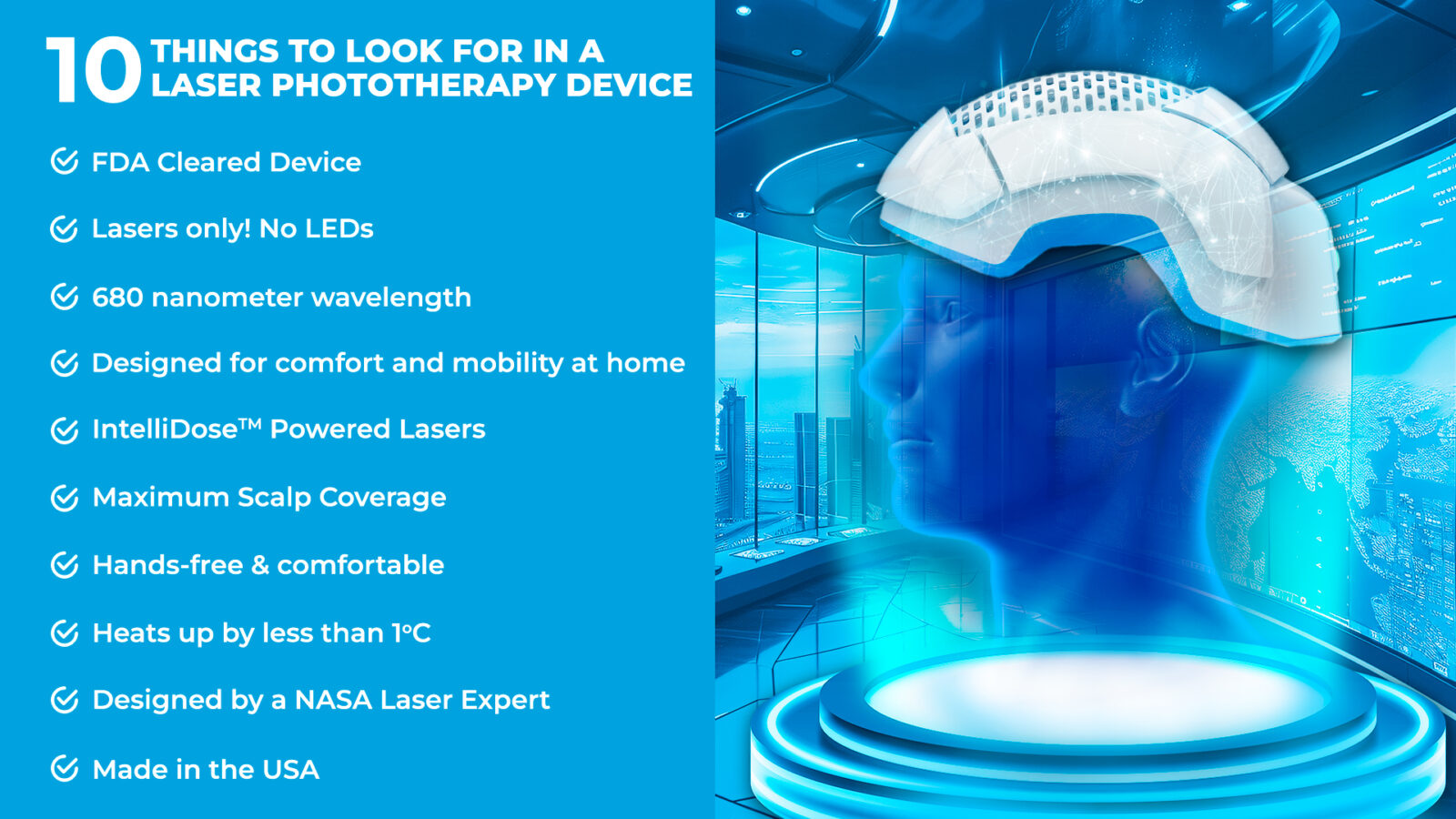
1. Check for FDA Clearance
Look, if the device is not FDA-cleared, just stop right there.
Because that FDA stamp is proof that the device passed safety and efficacy testing. It means the product’s been reviewed for performance and regulatory compliance. You don’t want to settle for a product that was just hyped by influencers.
2. Go for Lasers Only (No LEDs)
LEDs scatter light, whereas lasers focus it. With lasers, your follicles get coherent, hyper-targeted, and deep light.
But what’s the difference?
Lasers give real hair penetration and not surface-level shimmer like LEDs. In fact, every serious study on hair regrowth uses laser diodes, not LEDs.
3. Look for the 680-Nanometer Wavelength Sweet Spot
Science says that 680nm wavelength hits that biological jackpot. The 680-nm wavelength is deep enough to reach follicles. It’s specific enough to activate photobiomodulation, and it’s the wavelength that drives ATP production and cell recovery.
4. Comfort and Mobility are Non-Negotiable
The best devices are usually designed for real-life use cases. They’ve got to be hands-free, and wearable while you check emails or binge Netflix. Because if it feels kinda bulky or awkward, you’ll definitely skip sessions. And with laser therapy, consistency is non-negotiable.
5. IntelliDose™ or Smart Dosing Tech
Now, here’s where Theradome really stands out.
Theradome’s patented IntelliDose™ system ensures your scalp gets the exact laser dosage every session. And that consistency keeps your hair in the sweet zone. So, it’s not overstimulated nor underpowered.
6. Full-Scalp Coverage (Crown, Temples, and Beyond)
Look, don’t settle for partial treatment. Because only true full-coverage helmets ensure the crown, and virtually all sides receive equal exposure. Just think of it as a surround-sound for your follicles.
7. Minimal Heat, Maximum Comfort
Good laser devices operate cool, heating up by less than 1°C. If it feels like a sauna on your scalp, that means it’s poorly engineered. A well-built helmet like Theradome stays gentle and steady through every session.
8. Designed by Experts
Theradome’s edge was born from aerospace science. As mentioned earlier, founder Tamim was working on laser systems for the Space Shuttle before redirecting that precision to hair restoration. Safe to say literal rocket science is being applied to your scalp.
9. Made for Home Use
In this case, ease meets rigor. The best laser therapy helmets always combine medical-grade materials with user-friendly simplicity. They are safe enough for home use but engineered to clinical standards.
10. Made in the USA (for Quality You Can Trace)
Did you know that manufacturing location matters?
“Made in the USA” always mean higher safety oversight, and tighter production standards. So, with such devices, you know what’s touching your scalp.

LPT’s Proven Effectiveness for All Hair Loss Types in Both Men and Women
A 2021 review (Pillai et al.) found that low-level light therapy consistently stimulated hair growth in both men and women with androgenetic alopecia. Laser therapy significantly increased hair density versus sham treatments. PMC
If we combine that with prior RCTs, the evidence keeps stacking. So, whether it’s pattern baldness (the classic androgenetic alopecia affecting men (Norwood II–V) and women (Savin/Ludwig scale)), or other forms of thinning, results certainly show up. And yes, that includes postpartum shedding, and age-related thinning. Sure, the evidence outside AGA isn’t as rock-solid as we speak. But the wave of user experiences and smaller trials points in the same direction, and that’s healthier, denser hair across scenarios.
What LPT doesn’t help:
LPT doesn’t help scarring alopecia. And it doesn’t help active scalp infections, or autoimmune conditions. So if you’ve got sudden bald patches, or inflammation, see a dermatologist first. Always.
What Should You Expect from Laser Therapy?
Look, laser therapy isn’t a one-week miracle. And thank goodness we all know real biology takes time.
Most users usually slot in 2–3 sessions a week, around 20 minutes each. At first, the changes are subtle (almost unnoticeable). Like you get those micro-shifts you notice after 12–16 weeks. Then momentum builds. Fuller, thicker strands start to emerge around 4–6 months.
And for the dedicated ones who stick with it, they get peak density between 9–12 months. It’s steady and incredibly rewarding if you stay consistent.
Who Benefits Most from LPT & When to See a Doctor
LPT works best when used early. That is, when follicles are still active (mild to moderate AGA).
Of course, not all hair loss fits the LPT script. If you suddenly spot big bald patches, or your scalp shows angry red scaling, or painful sores, that’s not the time for DIY solutions.
The same goes if itching lingers more than a couple of weeks, or if you already have conditions like psoriasis, or eczema. In those cases, a dermatologist should be your first stop. Early evaluation rules out serious issues and keeps you on the safest path.
LPT vs. Other Alternatives
So why should you lean toward lasers instead of just slathering on minoxidil or shelling out for PRP injections?
First, LPT is drug-free. That means you don’t have no systemic side effects to worry about, unlike oral meds. It’s also infinitely more convenient than clinic-based treatments. I mean no needles. Also, no appointments. All you gotta do is pop on a helmet at home. And it works for both men and women (with FDA-cleared devices that cover both genders).
Sure, there’s an upfront cost. But stretch it over years and it’s often comparable to buying topicals month after month. Most importantly, it’s ideal for people who want a less invasive, lower-risk option to stay ahead of thinning.
But PRP and drugs still have roles. Sometimes the best approach is multiple modalities combined.
Conclusion: Non-Surgical, FDA-Cleared Hair Loss Solutions
Non-surgical hair restoration is here. Right now. Lasers are FDA-cleared, clinically proven tools that stimulate real follicle growth.
And at the center of that revolution sits Theradome… the first NASA-engineered, FDA-cleared laser helmet built for both men and women. It’s safe and designed so you can literally grow hair back while watching Netflix.
Truth is, you don’t need a cocktail of pills, or endless PRP appointments. Don’t waste your time (or your wallet) chasing “maybe.” Just grab a Theradome helmet, stay consistent, and let light do what science designed it to do: awaken your follicles and keep your hair thriving for years.
Because when you combine space-grade laser precision with real medical clearance, you don’t need anything else. You just need the right light.