
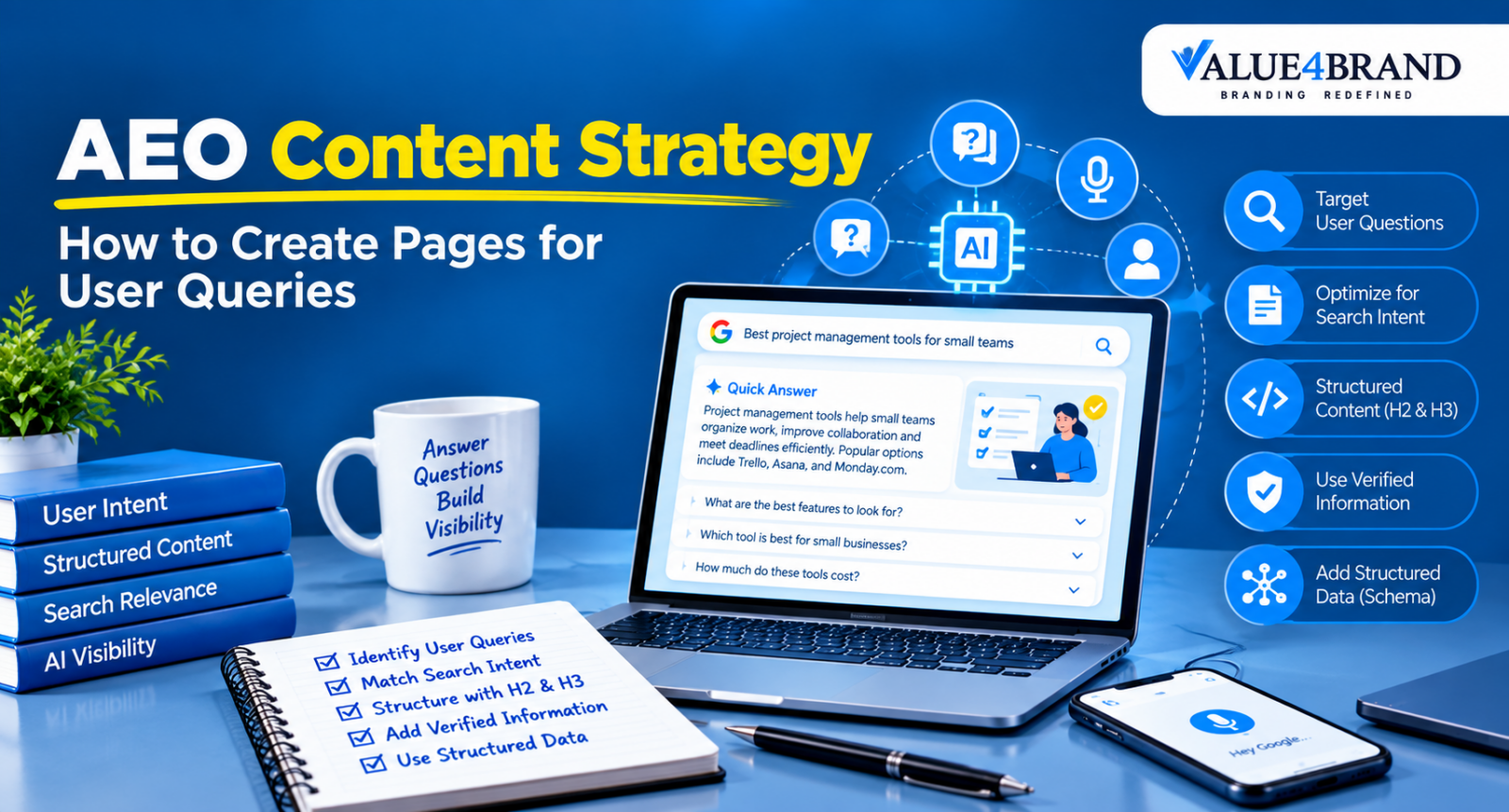

While conducting answer engine optimization, an important practice is to target user queries. Through an AEO content strategy, a business can create pages and structure them for answering those questions. The structure mainly includes H2 and H3 headings that focus on the questions people ask the most and are relevant to a particular brand or its products and services. Such an approach enables it to prepare pages that AI systems can understand and cite. At the same time, users can get the answers they need.
Reach out to us anytime — we’re just a message away !!
We’d love to hear from you! Whether you have a question, feedback, or just want to say hello, our team is here to help.
Schedule a Call
What is an AEO content strategy?
An AEO content strategy is an approach that offers direct responses or answers to online users’ questions. Its focus is on understanding the intent of people in order to create helpful content that answer engines can interpret with ease.
The goal of such a strategy is to make information accessible for users who use artificial intelligence-driven tools, search features, and voice assistants to look for answers.
How Does an AEO Content Strategy Target User Questions?
A strategy for AEO optimization targets users’ questions as per their search journey. It helps in identifying queries as well as planning content that gives direct yet clear answers to these. This tactic makes every web page highly useful for such users. At the same time, it helps search engines, along with AI-powered platforms, to assess the information provided.
How to Create Pages to Answer User Questions through AEO Content Strategy?
To build pages that focus on user questions, an effective AEO content strategy should help make it query-specific. After determining what people ask for, match the search intent. Then prepare the content structure and equip it with consistency and genuine information.
Identify Audience’s Questions
Using a content strategy for AEO, to structure pages for queries, start by detecting what users ask. They can inquire about related topics, products, services, etc. Make use of search queries, results in People Also Ask (PAA), forums, buyers’ conversations, as well as related searches. Then list down relevant questions.
Tip: Group similar queries and spot the main topics to address through web pages.
Match Each Page to a Clear Search Intent
Next, to create web pages that respond to people’s questions, the answer engine optimization strategy should focus on the search intent. Consider what users need to know through their questions. Add specific pages to offer in-depth explanations. Cover closely linked queries on one page instead of multiple ones with overlapping data.
Structure Pages around Queries and Direct Answers
When strategically utilizing AEO content tactics, one should select a primary question and make it the focus of a website page. Add a clear answer for the heading. Then add descriptive headings for H2 and H3 positions for every related question. Include supporting examples and explanations to answer them.
Incorporate Verified Yet Specific Information
Through an AEO content strategy, for structuring pages as per user queries, the answers need more attention. Thus, even the answers should be structured. They should comprise non-generic information to actually help users. Also, it should be verified through facts, dates, figures, etc., to be cited by AI systems.
Ensure Access to Important Data
On the web page, the answers added to the audience’s questions should carry relevant data that they look for. Keep important answers on HTML pages that are indexable. Avoid using PDFs or forms for this purpose so AI systems can access, interpret, and cite such a page.
Focus on Adding Structured Data
As part of an answer engine optimization strategy, while structuring pages for user questions,
schema markup should be appropriate. It should describe the content type and structure.
- In addition, structurally, the pages should carry headings for:
- Main questions
- Related questions
- Supporting product or service details
- Author information
- For every section, add meaningful, clear, and to-the-point information or responses.
- Across these, offer originality to be cited by AI platforms.
Create AEO-Optimized Pages with Value4Brand
Value4Brand is the leading AEO agency that can assist brands in creating answer engine optimization-focused pages. Through these, it can target user queries, mainly by detecting questions with high intent. It maps them to spot the intent and then structures the content around it. In doing so, straightforward answers are provided for these.
Expertise in Structuring Content for User-Focused Answers
The answer engine optimization agency, Value4Brand, has an experienced team that well understands the AEO content strategy to structuring content around user-based questions. Its knowledge of AEO as well as search intent enables the team to identify what users want to know. Accordingly, it organizes information. This approach results in the creation of pages with optimized answers.
- Value4Brand’s experts refine existing content on the pages to write specific answers for user queries.
- The related topics are also organized meaningfully for search engines and AI platforms to understand the content.
- Besides, it tracks the ongoing performance of the page and identifies the areas of improvement.
Connect with Value4Brand to structure pages for high-intent user queries through AEO.
Closing Remarks
An effective AEO optimization strategy for content is useful for creating pages that address the questions of users. Through relevant and structured data, their queries are responded to. By focusing on their search intent, the clarity of answers, and the helpful nature of content, businesses can improve information accessibility to improve their presence across AI systems.
FAQs
Q1. Why are user questions important for AEO?
The queries of users are important for answer engine optimization as they help a business understand what they want to know. By answering their questions, AEO content can provide relevant answers that are easy for AI platforms to detect.
Q2. How does AEO content target user search queries?
AEO content targets users’ search queries by finding out which questions are important and matching them with search intent. The pages are then structured to offer meaningful answers, on the basis of what users are searching for.
Q3. How do I identify queries users are searching for?
To identify queries that users are searching for, go through search results, the People Also Ask or PAA section, related searches, etc., across Google or other search engines. Besides, one can use keyword research tools to spot them.
Q4. Why are H2 and H3 headings important for AEO content?
H2 and H3 headings are important for AI-friendly content as they make it organized. It looks more structured around specific topics and questions. So, users can find the information they need quickly and AI platforms can get the context.
Q5. How to write answers for AEO-focused pages?
For writing answers for AEO-focused pages, create concise content for every question. Then provide supporting details for it. Include factually correct information, context, and examples that make the response useful.
Q6. What type of information should a structured AEO page have?
A structured answer engine optimization page should have main and related questions as well as relevant answers with examples and facts.
Q7. How does structured data influence AEO content?
Structured data provides additional information to search engines about the content and its purpose.
Q9. How to optimize existing pages for user queries through AEO?
First, review existing pages and then, using an AEO content strategy, identify questions that are already addressed, gaps in the answers, and new queries that should be resolved.