
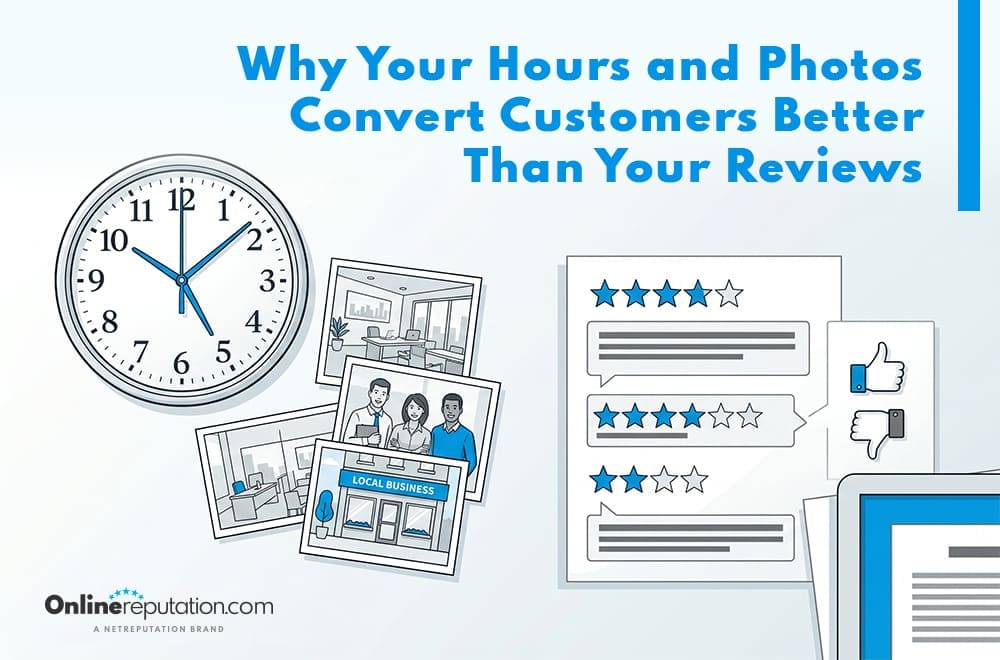

Most businesses obsess over their star rating. They chase reviews, respond to every comment, and stress over a 4.2 vs. a 4.6. Meanwhile, two simple signals on their Google Business Profile are quietly costing them customers every day — or winning them customers.
Your business hours. Your photos.
These are not flashy reputation signals. They do not generate press. But for a customer standing at the decision point — the moment they are about to choose you or your competitor — they matter more than almost anything else on your profile.
Here is why, and what to do about it.
What Customers Actually Do Before They Visit
Before a customer walks through your door, calls you, or places an order, they run a quick mental checklist. Search results, map pack, quick profile scan. It takes under 30 seconds. In that window, they are not reading your reviews in detail. They are pattern-matching for trust signals.
The questions running through their head:
- Is this place open right now?
- Does it look legitimate?
- Does it look like what I am looking for?
Your reviews answer a downstream question — is this place good? Your hours and photos answer the upstream question — should I even bother?
If those upstream signals fail, the customer never gets to your reviews.
Why Accurate Hours Are a Conversion Signal, Not Just Information
The trust cost of wrong hours
When a customer shows up and finds you closed — or calls and gets no answer during posted hours — the experience does not feel like a minor inconvenience. It feels like a broken promise. Research consistently shows that inaccurate business hours are among the top reasons customers leave negative reviews and, more importantly, never return.
Google itself factors in hours of accuracy as a local ranking signal. A profile with outdated or inconsistent hours across the web is a profile Google trusts less — which means lower local pack visibility.
Hours as a real-time purchase trigger
Consider what happens when someone searches for your service type at 7 pm on a Thursday. Google surfaces the map pack. Next to each listing, Google shows a status: Open, Closed at 8 PM, or Closed.
That single label does significant conversion work. A customer comparing three options will default to the open business — not because the other two are worse, but because the other two have removed friction and uncertainty.
Accurate, complete hours — including holiday, special, and service-specific hours where applicable — are a direct path to capturing demand that would otherwise go to a competitor.
What to audit right now
- Confirm your primary hours are current across Google, Bing, Yelp, Apple Maps, and your website
- Add special hours for every upcoming holiday (Google allows you to set these in advance)
- If you offer multiple services or locations, verify each listing separately
- Check that your hours are consistent across all citations — discrepancies hurt local SEO
Why Photos Convert Customers That Reviews Cannot Reach
The visual trust gap
A five-star review tells a customer someone else had a good experience. A photo shows them what their experience might look like. These are psychologically different propositions.
Photos trigger what researchers call pre-experience visualization — the brain’s tendency to mentally simulate an experience before deciding to pursue it. A restaurant photo does not just show food; it helps the customer picture themselves eating there. A law firm lobby photo does not just show an office; it signals professionalism, stability, and scale. A salon photo does not just show haircuts; it shows whether the aesthetic matches what the customer is looking for.
This is why businesses with more photos on their Google Business Profile consistently show higher engagement rates — more direction requests, more website clicks, more calls — than businesses with equivalent review scores but sparse visual content.
What photos customers actually look for
Not all photos carry equal weight. Customers prioritize different image types depending on the business category, but across industries, the highest-impact categories are:
Exterior photos: Customers want to know what to look for when they arrive. An exterior shot at your actual address, ideally showing your signage, reduces arrival friction and quietly signals that you are a real, established business.
Interior photos communicate atmosphere, cleanliness, and scale. For service businesses, they also signal how seriously you take the customer experience.
Product or service photos. For restaurants, retail, and e-commerce, these are often the first thing a customer wants to see. High-quality, accurate photos of your actual offerings outperform stock imagery in conversion.
Team photos for professional services — healthcare, legal, financial, consulting — photos of your actual team humanize your firm and reduce the anxiety of choosing a stranger to help with something important.
Customer experience in action Photos showing real customers (with permission) or your staff actively working signal a busy, legitimate operation and help potential customers see themselves in the experience.
The quality-quantity balance
Google recommends a minimum of 10 photos for a complete profile. But quality matters more than raw count. One sharp, well-lit exterior photo outperforms five blurry ones. A single compelling interior shot beats a gallery of stock images.
The standard to aim for: photos that accurately represent what a customer will experience. Overpromising visually creates the same trust damage as fake reviews. Accurate, high-quality photos set the right expectation — and customers who arrive with accurate expectations convert better, stay longer, and review more favorably.
How Hours and Photos Work Together in AI Search
This is increasingly important for local businesses to understand.
When Google’s AI Overview, or a tool like ChatGPT or Perplexity, synthesizes a recommendation in response to a local query, it draws from structured data sources — and Google Business Profile is one of the most weighted. The AI does not just pull your star rating. It reads your category, your hours, your attributes, and increasingly, interprets your photo content.
A profile that is complete, current, and visually rich gives AI systems more to work with — and more confidence to surface your business in response to relevant queries. A sparse profile with outdated hours and three photos from 2019 gives AI systems very little signal to work with.
For local businesses building an AEO strategy, GBP completeness is not a nice-to-have. It is foundational.
Structured signals AI looks for in GBP profiles:
- Category accuracy and specificity
- Hours completeness and consistency with other sources
- Photo recency and diversity
- Attribute completeness (accessibility, payment methods, service options)
- Q&A section activity
- Response rate and recency of review responses
The Hierarchy of Conversion Signals on a Google Business Profile
To put this all together, here is how GBP signals stack in terms of customer decision-making:
1. Availability (hours) — Is this business open and accessible right now? 2. Visual credibility (photos) — Does this business look like what I am looking for? 3. Social proof (reviews) — Do other customers confirm this is a good choice? 4. Business details (categories, attributes) — Do the specifics match my needs?
Reviews sit third in this hierarchy — not because they do not matter, but because they are not evaluated unless signals one and two first earn the customer’s attention.
The businesses that win local search are not always the ones with the most reviews. They are the ones whose profiles answer the customer’s first two questions — are you open, and do you look right — clearly, quickly, and convincingly.
Practical Checklist: Hours and Photos Optimization
Hours
- Verify all primary hours are accurate today
- Add hours for all relevant days, including Sundays and holidays
- Set holiday hours at least two weeks in advance
- Confirm hours match across Google, Bing Places, Yelp, Apple Maps, and your website
- Use Google’s “More hours” feature for services with different schedules (e.g., drive-through, delivery, senior hours)
Photos
- Upload a current, high-quality exterior photo
- Upload at least two interior photos showing the space clearly
- Upload photos of your primary products or services
- Add a team or staff photo if relevant to your category
- Remove or replace any outdated, blurry, or inaccurate photos
- Set a compelling cover photo that represents your brand
- Aim to refresh photos at least quarterly
The Bottom Line
Your star rating is a lagging indicator. It reflects what past customers thought. Your hours and photos are present-tense signals — they tell the customer considering you right now whether you are open, real, and worth their time.
Most businesses under-invest in both because neither feels as visible or emotionally satisfying as chasing a review. But in the sequence of decisions a local customer makes, getting these two signals right is the prerequisite for everything else.
Fix your hours. Invest in your photos. Then your reviews will have the audience they deserve.