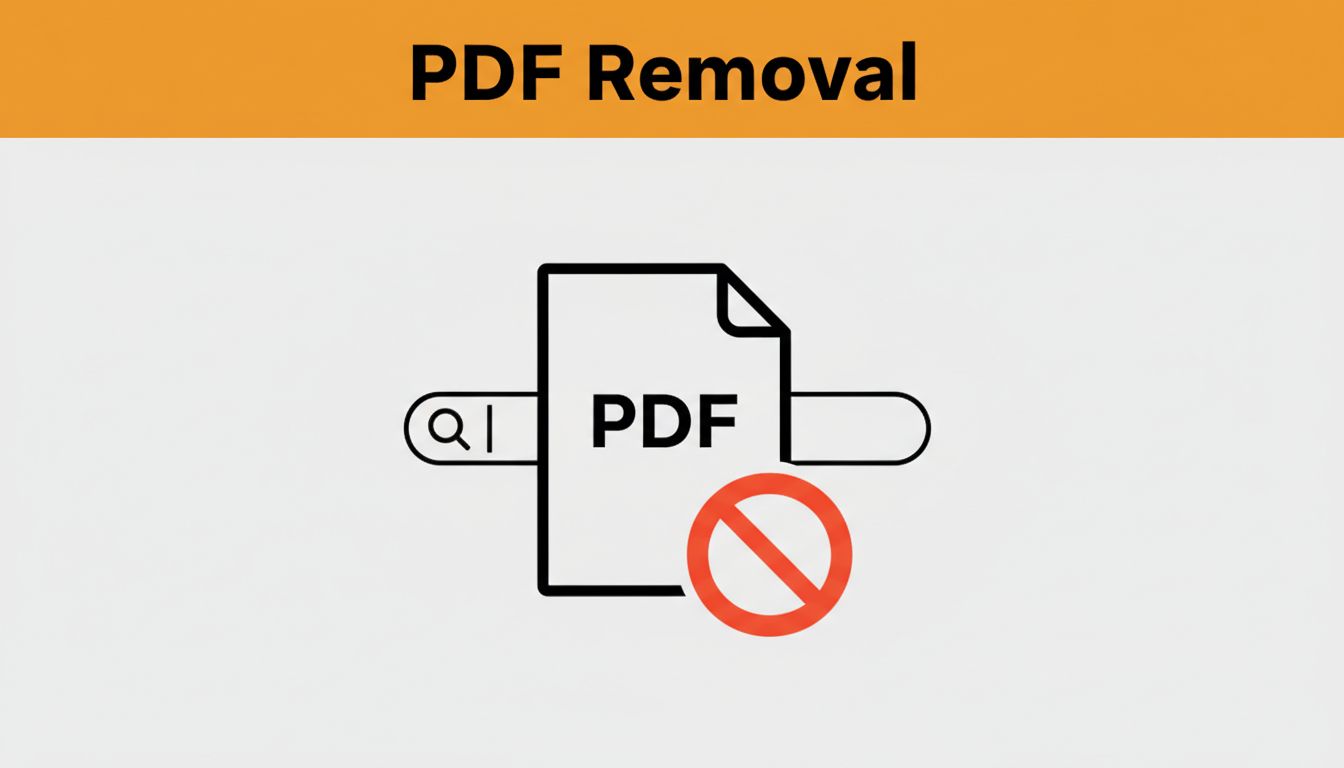

PDFs are easy to publish and hard to pull back once Google finds them. If an old brochure, rate sheet, contract, or internal memo is still showing in Search, the fix depends on your goal, not guesswork.
You may need a fast hide while you clean up the source file. You may need the PDF gone for good. Sometimes the best answer is to replace it with a cleaner HTML page that can rank and update better.
Choose the right removal path
Before you touch the file, decide which result you want. Google offers different tools for different problems, and the right one depends on whether the PDF is sensitive, outdated, or still useful.
Google’s Remove web results from Google Search page and the Removing information help center page are the current references for the options that still work in 2026.
| Goal | Best method | What Google does |
|---|---|---|
| Hide the PDF fast | Search Console Removals tool | Hides the URL and clears the snippet and cache temporarily |
| Remove it permanently | X-Robots-Tag: noindex, or return 404/410 |
Drops the file after Google recrawls it |
| Keep the content, but improve it | 301 redirect to HTML | Sends users and Google to the replacement page |
If the file is embarrassing, sensitive, or outdated, start with the temporary hide, then finish the backend change. That keeps the PDF out of sight while you wait for recrawl.
Temporary removal buys time, not closure
Use the Removals tool when you need the PDF to disappear quickly. It is the fastest option, but it is temporary, usually about six months, and it does not change the source file on the server.
A simple workflow keeps the process clean:
- Confirm the PDF URL is the one you want removed.
- Open Search Console and use the Removals tool for that exact URL.
- Make the server-side change at the same time, so the hide becomes permanent later.
- Use URL Inspection with Live Test, then request indexing after the fix is live.
Robots.txt can block crawling, but it does not erase an already indexed PDF. If Google cannot crawl the file, it also cannot see a new noindex header.
That point matters. If you block the PDF in robots.txt before Google sees X-Robots-Tag: noindex, the old result can linger much longer than you expect.
Make Google drop the PDF for good
For PDFs, permanent removal usually happens at the HTTP layer. Add X-Robots-Tag: noindex to the PDF response, then let Google recrawl the URL. This works because PDFs do not have an HTML where you can place a meta robots tag.
The status code matters too. A 404 says the file is missing. A 410 says it is gone on purpose. Both can work, but a 410 gives Google a cleaner signal when the content is retired for good. If you are replacing the PDF with HTML, use a 301 redirect instead.
A few practical checks help here:
- Test the PDF headers in your browser network tab or with
curl -I. - Confirm the response really includes
X-Robots-Tag: noindex. - Wait for a recrawl, because cache and snippets often lag behind the server change.
- Check the Indexing report until the old URL drops out.
Fast-moving sites recrawl sooner. Slower sites can take days, or longer. In other words, the backend fix does the real work, and Search Console only speeds up the next crawl.
Replace the PDF when the content still matters
Some PDFs should not vanish. If the content is still useful, turn it into an HTML page and redirect the PDF to that page. HTML is easier to update, easier to measure, and easier to improve over time.
That choice is common in online reputation management, because a PDF that ranks for a brand name can keep showing long after the issue has changed. In those cases, a stronger HTML page can take the place of the file and support a broader cleanup plan. If you are doing larger site cleanup, online reputation management services can help connect the technical fix with search visibility.
A canonical tag can point to the HTML version, but it will not force Google to remove the PDF. Use it as a hint, not as your only move.
When the PDF is part of a bigger brand problem
Sometimes one PDF is only the symptom. If the file sits alongside bad press, outdated bios, or old legal language, you may need more than a server change. That is where reputation management, online reputation management, and online reputation repair start to overlap.
A reputation management company or an Online Reputation Expert can decide whether to remove the file, replace it, or pair both moves with stronger content. Many online reputation management companies and a Reputation Repair Company use that same approach, because the goal is not just deletion. It is better search results. The right Reputation Repair Services keep the old PDF from becoming the first thing people find.
That is also where online reputation repair guide fits, especially when the cleanup needs to include suppression, content updates, and search monitoring.
Conclusion
The cleanest fix depends on the outcome you want. Use Search Console for a fast hide, use X-Robots-Tag, 404, 410, or a 301 redirect for the real fix, and give Google time to recrawl the URL.
Most mistakes happen when people stop at robots.txt. If the PDF is already indexed, Google needs a signal it can crawl and understand. Once that happens, the result usually follows.