
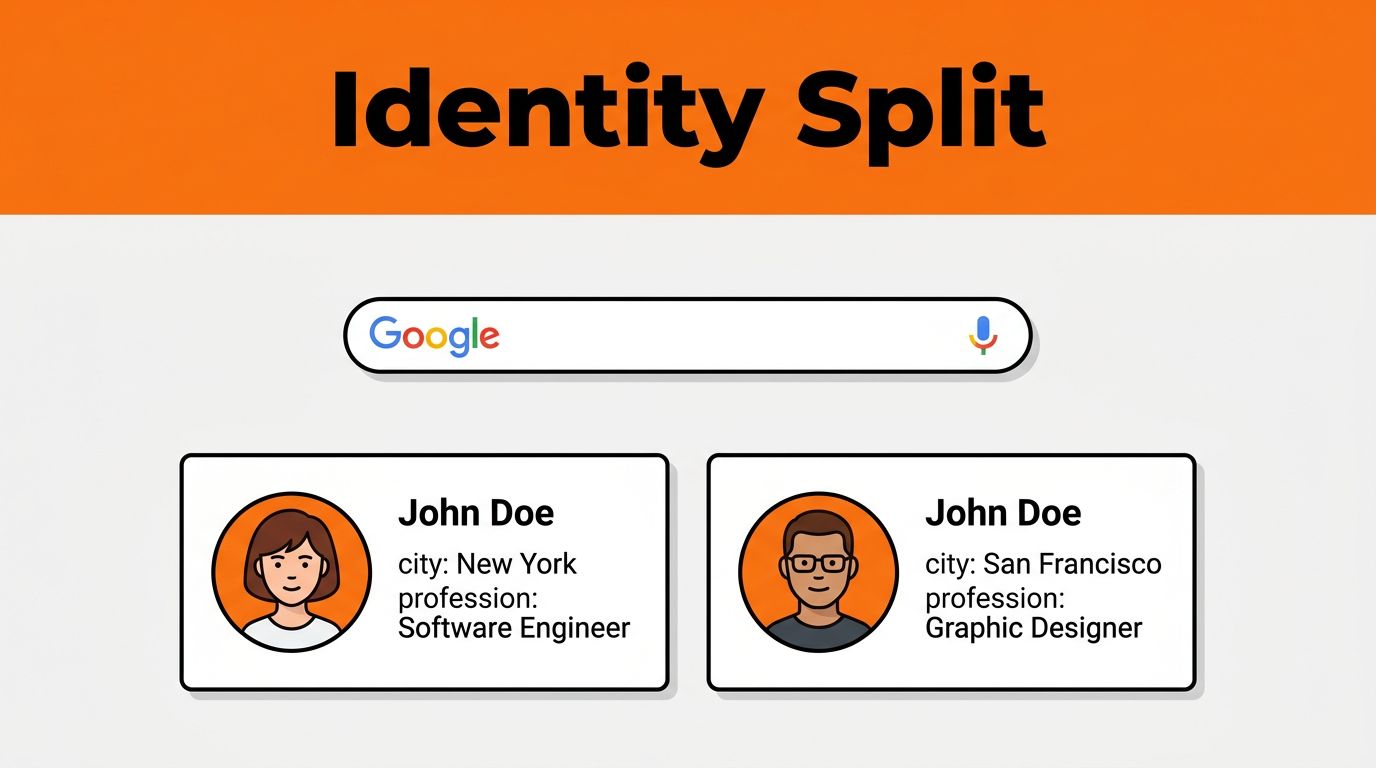

Google doesn’t see a name the way people do in same name search results. It sees a pile of personal information, then tries to decide which person that information points to.
That matters when same name search results blend two people into one messy page of search engine results. If you’re an SEO, a PR lead, or the person caught in the mix-up, the fix is usually not one big move. It’s a set of consistent signals that make your identity easier to verify.
Key Takeaways
- Google mixes up same name search results due to weak corroborating signals, falling back on prominent profiles; consistent bios, locations, professions, and sources across the web provide the evidence needed for separation.
- Key signals include consistent identifiers (profession, city, employer), Person schema metadata, profile uniformity, topical authority, and branded search queries that tie facts to your unique entity.
- Build separation starting with owned assets: a clear personal site or About page, uniform identity wording everywhere, structured data, focused content, and third-party mentions repeating the same facts.
- Recent 2026 AI updates reward cleaner entity definition, but SEO influences signals without direct control; reputation management helps with harmful associations or complex overlaps.
Why Google mixes up people with the same name
A shared name creates a named entity identity problem, not only a keyword problem. Google has to work out whether “Michael Lee” means the lawyer in Chicago, the product manager in Seattle, or the musician in Toronto.
When signals are weak, search engine algorithms fall back on whatever looks most prominent. That can mean a stronger media profile, an older Wikipedia mention, or a more searched person with the same name. Kalicube calls this the dominant entity problem in knowledge panels.
Corroboration is the real divider. One profile saying “I am Jane Carter, a tax attorney in Miami” is a claim. Ten matching sources saying the same thing becomes evidence. If your bios, employer pages, social profiles, author pages, and press mentions all provide consistent biographic information, Google has more confidence that your entity is separate.
This is also why random, inconsistent profiles hurt. A LinkedIn page with no location, an old bio with a former employer, and a personal site with no clear niche send mixed messages. As a result, data overlap causes Google to merge signals that should stay apart.
How Google separates people in 2026
Recent core changes in early 2026, powered by advanced AI search tools, appear to reward cleaner entity definition and stronger corroborating sources. Google hasn’t published a same-name playbook, but the direction is clear: clearer identity wins.
At a technical level, Google tries to map names to entities, then tie those entities to facts using contextual information. Google’s own entity extraction overview explains the basic idea. Its systems look for names, places, organizations, roles, and relationships. Then they compare those clues across the web.
Google doesn’t rank a name alone. It tries to rank the person behind the name.
That means five signals matter most for improving search presence and search rankings:
- consistent identifiers, such as profession, city, employer, and niche
- metadata, especially Person schema and sameAs links
- profile consistency across owned and third-party pages
- topical authority, so your web presence centers on one clear subject area
- branded search queries, where people search for your full identity string, not only your name
A good public example came from Search Engine Land’s case study on the two Danny Goodwins. The separation improved when the right facts, sources, and associations became easier for Google to confirm. Google has also shared how it identifies Knowledge Graph entities in image results, which shows how broad its entity systems now are.
Build separation signals Google can verify
You don’t need a huge brand to fix same name search results. You need a strong digital presence with a clear identity trail.
Start with your owned assets, because they’re the easiest to control.
- Create a personal site or a strong About page. Put your full name in the title, then add your role, employer, location, and niche in plain language. Don’t write a vague bio. Write the version you want Google to understand. This contextual information provides authentication data search engines can verify.
- Use one identity format everywhere. If you’re “Dr. Sarah Lin, pediatric dentist in Austin,” keep that wording close across your search profiles on social media platforms like LinkedIn, your company bio, conference pages, podcast guest pages, and author bylines. Consistent profile information reinforces your digital presence.
- Add structured data. A Person schema page should connect your name to your job title, worksFor, alumni, location, and official profiles. This won’t force rankings, but it gives search engines cleaner authentication data.
- Tighten topical authority. If your site mixes marketing posts, travel diaries, crypto commentary, and recipe content, the entity gets fuzzy. Keep your professional pages focused on the topic you want tied to your name.
- Build corroborating mentions. Ask podcast hosts, event organizers, publishers, and industry directories to use the same short bio. The more independent sources repeat the same facts, the better.
Branded searches help, too. Put your full identity string in email signatures, speaker bios, media kits, and author boxes. “Alex Morgan healthcare attorney Boston” is far easier for Google to separate than “Alex Morgan.” This distinction unlocks professional opportunities essential for career growth.
If the problem includes harmful or false associations, these online reputation repair services and this reputation repair services guide offer a practical next layer.
What SEO can influence, and what it can’t
You can influence search results. You can’t command them.
That’s the line many teams miss. SEO can shape the evidence Google sees, but it can’t directly assign a knowledge panel, remove a true article, or promise that one result will stay in one position. In other words, same name search results improve through stronger signals, not through a control panel.
This is where online reputation management overlaps with identity SEO. A reputation management company may help unify bios, social profiles, schema, and press coverage against unwanted search results from data brokers and public records. Some online reputation management companies also handle online reputation repair when false associations, misleading content, or bad results from data collection muddy the picture. In tougher cases, a Reputation Repair Company, an Online Reputation Expert, or formal Reputation Repair Services can support a broader reputation management services plan.
For executives and founder-led brands, the issue often spills into company visibility, too. In those cases, online reputation management for businesses can help align personal and brand search results, alongside tools like data removal services and privacy protection laws.
The strongest fix is also the simplest: make it easy for Google to tell a consistent story about one real person. When your site, bios, schema, and third-party mentions all match, confusion has less room to grow.
That won’t happen overnight. Still, it does happen faster when every signal points to the same identity.
Frequently Asked Questions
Why does Google mix up people with the same name?
Google treats shared names as a named entity identity challenge, mapping them to facts like locations and roles across the web. Weak or inconsistent signals lead algorithms to merge profiles based on prominence, such as media coverage or search volume. Strong corroboration from multiple matching sources is what separates distinct individuals.
What are the most important signals for separating same name search results?
Consistent identifiers like profession, city, employer, and niche top the list, alongside Person schema, sameAs links, uniform profiles, topical authority, and branded searches. These provide verifiable evidence tying your name to a unique entity. Recent AI advancements in 2026 emphasize these cleaner signals over vague or overlapping data.
How do I build separation signals on my own?
Start with a personal site featuring your full identity in the title and bio, use one consistent format across social profiles and bylines, add Person schema markup, focus content on your niche, and secure matching bios from third-party sources. Branded queries like ‘YourName role city’ in signatures and media kits reinforce distinction. Changes take time but compound as signals align.
Can SEO guarantee control over same name search results?
SEO shapes the evidence Google sees through stronger signals but can’t assign knowledge panels, remove true content, or lock result positions. It influences presence and separation indirectly via consistency and authority. For harmful or stubborn issues, online reputation management provides additional tools like data removal and profile unification.
When should I consider reputation management services?
Use them for false associations, data broker overlaps, or when basic signals aren’t enough against dominant entities. Services unify bios, handle press, and apply privacy protections, especially for executives where personal and brand results intersect. They complement entity SEO in tougher online reputation repair cases.